

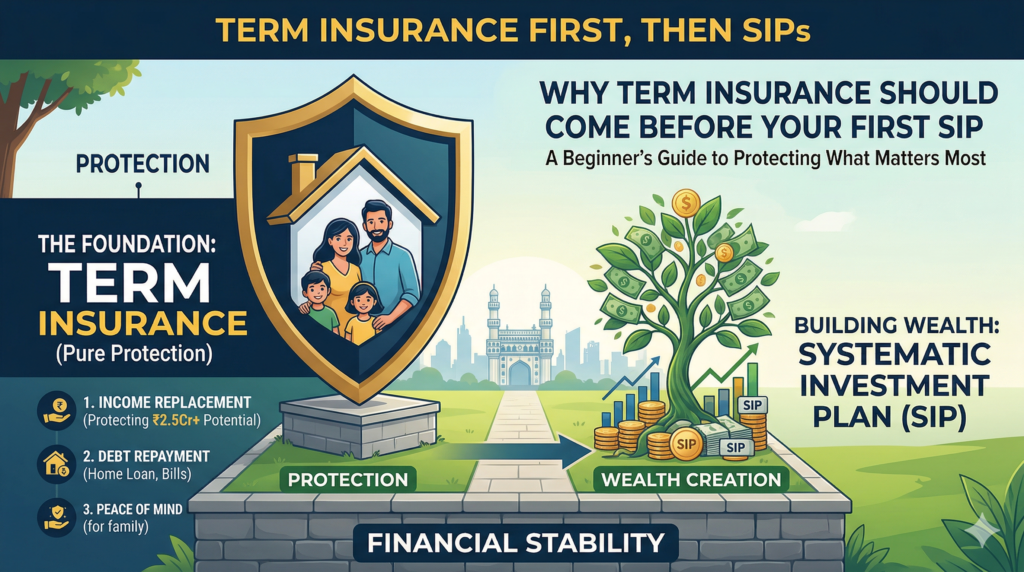
A beginner’s guide to protecting what matters most
Imagine this. Ravi is 34 years old, works at an IT company in Hyderabad, and earns ₹12 lakh a year. He has been dutifully investing in mutual funds for two years. His SIP portfolio is growing. He feels good about his finances.
Then one day, unexpectedly, Ravi is no longer there.
His wife, two children, and ageing parents are left behind — along with a home loan EMI of ₹35,000, school fees, monthly expenses, and zero savings beyond what was in the mutual fund. The portfolio, while growing, covers only about 8 months of household expenses. After that, the family has nothing.
Ravi never bought term insurance. He thought he would “get to it later.”
This is not a hypothetical. Variations of this story play out across thousands of Indian families every year. And it is entirely preventable.
So what exactly is term insurance?
Term insurance is the simplest form of life insurance. You pay a premium every year (or month) for a fixed period — say 30 years. If you pass away during that period, your family receives a lump sum called the sum assured. If you survive, the policy simply ends with no payout.
That is it. No investment component. No maturity benefit. Pure, straightforward protection.
Think of it like car insurance. You pay every year hoping you never have to use it. But if something goes wrong, it saves everything. Nobody calls car insurance a “waste of money.”
A ₹1 crore term insurance policy for a healthy 30-year-old non-smoker typically costs somewhere between ₹700 to ₹1,000 per month. That is less than most people spend on food delivery in a week.
Why is term insurance so important?
1. Your income is your family’s most valuable asset
If you earn ₹10 lakh per year and have 25 working years ahead of you, your future earning potential is approximately ₹2.5 crore — and that is without accounting for salary growth. That earning potential disappears the moment you do. Term insurance replaces this lost income for your family.
2. Your loans do not die with you
If you have a home loan, car loan, or personal loan, your family inherits that liability. Without insurance, they may be forced to sell the house or deplete their savings just to service debt. A term plan immediately eliminates this burden.
3. It is shockingly affordable
| ₹800 Approx. monthly premium |
₹1 Crore Typical cover amount |
30 years Coverage period |
The figures above are for a 30-year-old in good health. Premiums increase significantly with age — which is why buying early is so important.
4. It protects everyone who depends on you
Spouse, children, parents — whoever depends on your income is protected. The lump sum payout gives your family time to grieve, adjust, and rebuild without financial panic.
5. It gives you peace of mind to invest confidently
When you know your family is protected no matter what, you can invest for the long term without anxiety. Your SIPs can stay invested through market crashes because you are not relying on them as a safety net.
The big mistake most people make
Many people in India have life insurance — but not the right kind. LIC endowment plans, money-back policies, and ULIPs are commonly sold as “insurance” but they are actually a mix of insurance and investment, and they do both poorly.
Typical endowment plans offer a sum assured of ₹10–20 lakh for a premium that could buy ₹1 crore of pure term cover. The insurance component is dangerously low, and the investment returns are mediocre.
Rule of thumb: keep insurance and investment completely separate. Buy term insurance for protection. Invest in mutual funds for wealth creation. Never mix the two.
How much cover do you need?
A simple and widely accepted rule is to have term insurance worth at least 10 to 15 times your annual income.
So if you earn ₹10 lakh per year, you need a minimum cover of ₹1 crore — ideally ₹1.5 crore. If you have a large home loan or dependants with special needs, go higher.
Also consider the policy term. Your cover should last at least until your youngest child becomes financially independent and your home loan is fully paid off. For most people in their 30s, a 30-year policy makes sense.
The right order of financial planning
Before you start investing a single rupee, make sure these three things are in place:
- An emergency fund covering 3 to 6 months of your household expenses
- A term insurance policy with adequate cover
- A health insurance policy for yourself and your family
Only after these three foundations are secure should you begin investing in mutual funds, stocks, or any other asset class. Investing without this foundation is like building a house without a floor.
What should you do next?
If you do not have a term insurance policy today, that is the single most important financial task on your list — ahead of SIPs, ahead of tax saving, ahead of everything else.
Get a policy in place this month, not next quarter. Premiums are at their lowest right now, and the cost of delay is real — both financially and for your family’s security.
If you are unsure how much cover you need, which insurer to choose, or how to evaluate a policy, reach out for a free consultation. Getting this right is more important than any stock pick or fund selection.
Your family’s future is worth one hour of your time.
Great article, simple and easy to understand. Thank you for the advice.