

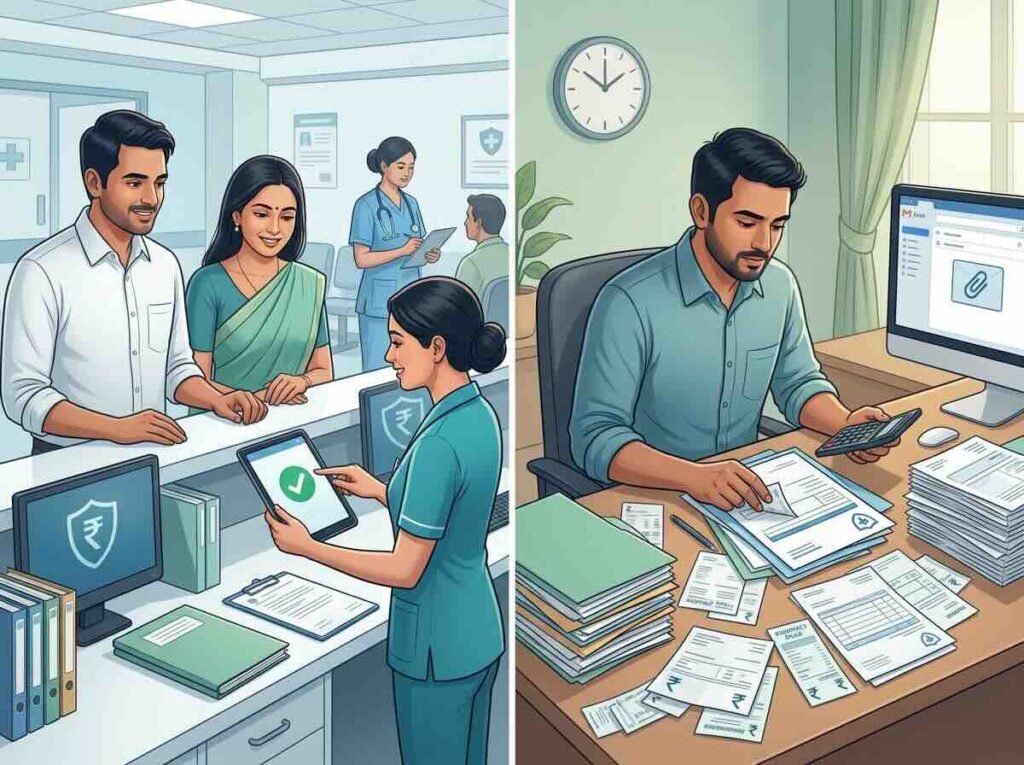
When you are hospitalised and need to file a health insurance claim, you generally have two options: cashless treatment or reimbursement. Understanding how each works — and when to use which — can save you from confusion and out-of-pocket stress at the worst possible time. Let us break it down clearly.
What is cashless treatment?
In cashless treatment, you receive medical care at a hospital without paying the bill upfront. The insurer settles the bill directly with the hospital after pre-authorisation.
How it works, step by step:
1. You (or a family member) go to a hospital in your insurer’s network
2. Show your health insurance card or policy number at the insurance desk
3. The hospital sends a pre-authorisation request to the insurer
4. The insurer approves and sends an authorisation letter (usually within a few hours for planned admissions, or faster for emergencies)
5. You receive treatment; the hospital bills the insurer directly
6. At discharge, you only pay for items not covered by the policy (co-pays, non-covered items)
Cashless only works at network hospitals — hospitals that have a tie-up with your insurer’s Third Party Administrator (TPA).
What is reimbursement?
In reimbursement, you pay the full hospital bill yourself and then claim the money back from your insurer.
How it works:
1. Get treated at any hospital (network or non-network)
2. Pay the full bill at discharge
3. Collect all original bills, discharge summary, prescriptions, and investigation reports
4. Submit a claim form along with all documents to your insurer within the stipulated time (usually 15–30 days)
5. The insurer reviews and reimburses the eligible amount
Reimbursement allows you to go to any hospital, including those not in the insurer’s network.
Key differences at a glance
Cash outflow: Cashless — none upfront; Reimbursement — full bill upfront
Hospital choice: Cashless — network hospitals only; Reimbursement — any hospital
Speed: Cashless — faster approval process; Reimbursement — takes 7–30 days after submission
Documentation: Cashless — hospital handles most of it; Reimbursement — you must collect and submit everything
Risk: Cashless — insurer may reject at last minute; Reimbursement — you are out of pocket until claim is settled
When to use cashless
Use cashless treatment when:
– It is a planned hospitalisation (surgery, delivery, procedure)
– A network hospital with good facilities is available
– You want to avoid the hassle of documentation and out-of-pocket payment
For planned procedures, you can even verify pre-authorisation a day or two before admission — giving you certainty that your claim will be approved.
When to use reimbursement
Use reimbursement when:
– It is an emergency and the nearest suitable hospital is not in the network
– You prefer a specific doctor or hospital that is not on the panel
– Cashless authorisation is rejected (you can still pay and claim reimbursement)
Important: Always keep original bills and documents — photocopies are generally not accepted for reimbursement claims.
Common reasons for claim rejection — and how to avoid them
1. Not informing the insurer within the stipulated time — Call the insurer’s helpline as soon as you are admitted.
2. Treatment at non-network hospital without emergency justification
3. Claiming for exclusions — cosmetic procedures, fertility treatments, self-inflicted injuries, certain pre-existing conditions within waiting periods
4. Incomplete documentation — always collect the discharge summary, OT notes, all bills, and doctor prescriptions
5. Policy lapsed — always keep your premium payments up to date
Read your policy’s exclusion list once when you buy it. Do not discover exclusions at claim time.
The bottom line
Cashless is more convenient for planned hospitalisations at network hospitals. Reimbursement gives you flexibility but requires you to have the funds upfront and manage documentation carefully.
Know your insurer’s network hospitals, keep your policy card handy, and keep the claims helpline number saved on your phone. The best time to understand your policy is before you need it.