

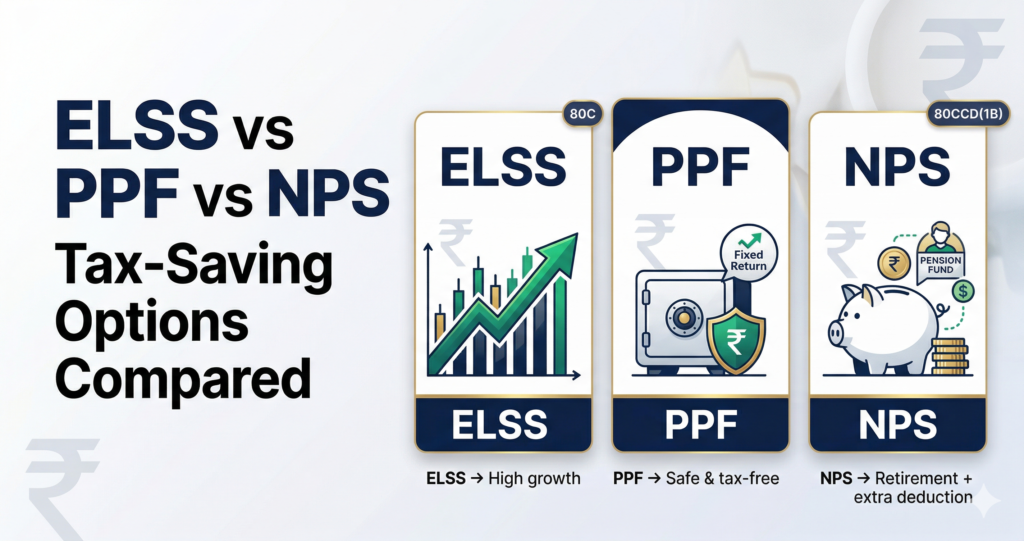
Every year, as the financial year end approaches, many of us scramble to make tax-saving investments before March 31. But rushing into any investment without understanding it can cost you in the long run. Under Section 80C of the Income Tax Act, you can claim a deduction of up to ₹1.5 lakh per year. Let us look at the three most popular options and help you choose what is right for you.
Option 1: ELSS (Equity Linked Savings Scheme)
ELSS is a type of mutual fund that qualifies for 80C deduction. It invests primarily in equity (stocks) and has the shortest lock-in period among all 80C options — just 3 years.
Key features:
– Lock-in: 3 years (shortest among 80C options)
– Returns: Market-linked, historically 10–14% CAGR over long periods
– Risk: High (equity-linked)
– Tax on returns: Long-term capital gains above ₹1 lakh taxed at 10%
– Minimum investment: As low as ₹500 per month via SIP
Best for: People who want wealth creation along with tax saving, have a long investment horizon (5+ years), and can tolerate market volatility.
Option 2: PPF (Public Provident Fund)
PPF is a government-backed savings scheme offering guaranteed, tax-free returns. It follows the EEE (Exempt-Exempt-Exempt) tax structure — meaning contributions, interest earned, and maturity amount are all tax-free.
Key features:
– Lock-in: 15 years (partial withdrawal allowed after 7 years)
– Returns: Currently around 7.1% per annum (fixed, reviewed by government quarterly)
– Risk: Zero — fully backed by the Government of India
– Tax on returns: Completely tax-free
– Minimum investment: ₹500 per year; maximum ₹1.5 lakh per year
Best for: Conservative investors who prioritise safety and guaranteed returns, people planning for retirement, and those in higher tax brackets who want tax-free income.
Option 3: NPS (National Pension System)
NPS is a government-regulated pension scheme designed to help you build a retirement corpus. It offers an additional deduction of up to ₹50,000 under Section 80CCD(1B) — over and above the ₹1.5 lakh 80C limit.
Key features:
– Lock-in: Until age 60 (partial withdrawal allowed for specific needs)
– Returns: Market-linked (mix of equity and debt based on your choice), typically 9–11% historically
– Risk: Moderate — you choose the equity-debt allocation
– Tax on withdrawal: 60% of corpus is tax-free at maturity; 40% must be used to buy an annuity (which is taxed as income)
– Additional deduction: Up to ₹50,000 extra deduction under 80CCD(1B)
Best for: People who want to specifically save for retirement, those in the 30% tax bracket looking for extra deductions beyond ₹1.5 lakh, and long-term disciplined savers.
Side-by-side comparison
Let us compare the three options at a glance:
ELSS → Lock-in: 3 years | Returns: 10–14% (market-linked) | Risk: High | Tax on returns: 10% LTCG above ₹1L | Best for: Wealth creation + tax saving
PPF → Lock-in: 15 years | Returns: 7.1% (fixed) | Risk: Zero | Tax on returns: Nil (EEE) | Best for: Safe, long-term, tax-free savings
NPS → Lock-in: Till age 60 | Returns: 9–11% (market-linked) | Risk: Moderate | Tax on returns: 60% tax-free | Best for: Retirement planning + extra 80CCD deduction
Which one should you choose?
You do not have to pick just one. A smart combination might look like this:
For a 30-year-old salaried professional:
– ELSS SIP of ₹8,000/month = ₹96,000/year (flexible, liquid after 3 years)
– PPF ₹54,000/year (safe, long-term foundation)
– NPS ₹50,000/year (extra 80CCD deduction, retirement focus)
This covers the full ₹1.5 lakh 80C limit plus ₹50,000 extra via NPS = ₹2 lakh total deduction, potentially saving ₹60,000 or more in taxes at the 30% bracket.
A word of caution
Many people invest in LIC endowment or money-back policies under 80C. While they do qualify, they offer very low returns (typically 4–5%) and poor insurance coverage. Unless you have specific reasons, ELSS, PPF, or NPS are almost always better choices.
Also remember: under the new tax regime, Section 80C deductions are not available. Check which regime suits you before investing purely for tax saving.