

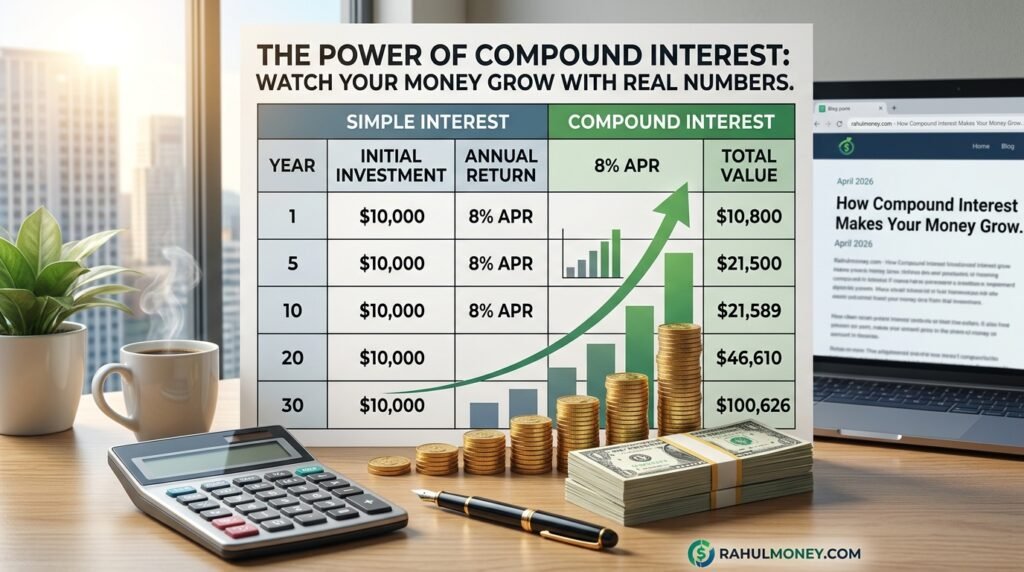
Albert Einstein is often (perhaps apocryphally) credited with calling compound interest the eighth wonder of the world. Whether he said it or not, the sentiment is absolutely correct. Understanding compound interest is arguably the single most important financial concept you can learn — because it is the engine behind every SIP, every mutual fund, and every long-term investment. Let us understand it with real numbers.
Simple interest vs compound interest
Simple interest: You earn interest only on the original principal.
Compound interest: You earn interest on your principal AND on the interest you have already earned. Over time, you are earning interest on a growing base — and this is where the magic happens.
Example:
You invest ₹1,00,000 at 10% per annum.
With simple interest after 10 years: ₹1,00,000 + (₹10,000 × 10) = ₹2,00,000
With compound interest after 10 years: ₹1,00,000 × (1.10)^10 = ₹2,59,374
You earn ₹59,374 extra — without doing anything different — just because of compounding.
The Rule of 72
Here is a simple mental shortcut to understand compounding speed:
Divide 72 by your annual return rate. The answer is roughly how many years it takes to double your money.
Examples:
– 6% return (FD): 72 ÷ 6 = 12 years to double
– 9% return (hybrid fund): 72 ÷ 9 = 8 years to double
– 12% return (equity fund): 72 ÷ 12 = 6 years to double
– 15% return (small cap): 72 ÷ 15 = 4.8 years to double
At 12%, your money doubles every 6 years. So ₹1 lakh becomes ₹2 lakh at year 6, ₹4 lakh at year 12, ₹8 lakh at year 18, and ₹16 lakh at year 24 — all from the original ₹1 lakh.
The power of time: starting early
The most powerful variable in compounding is not the return rate — it is time.
Let us compare two investors, Priya and Raj:
Priya starts at 25, invests ₹5,000/month until 35, then stops. Total invested: ₹6 lakh.
Raj starts at 35, invests ₹5,000/month until 55. Total invested: ₹12 lakh.
Both earn 12% annual returns. At age 60:
Priya’s corpus: approximately ₹1.76 crore
Raj’s corpus: approximately ₹49 lakh
Priya invested HALF the money but ends up with 3.5 TIMES more. Those extra 10 years of compounding are worth more than 20 years of later contributions.
This is why the most valuable financial advice for a 22-year-old is simply: start now.
How SIPs use compounding
A SIP is essentially compounding in action. Every monthly investment earns returns, those returns get reinvested, and the whole pool grows.
Here is what a ₹5,000/month SIP at 12% CAGR looks like over time:
5 years: Total invested ₹3 lakh → Corpus approximately ₹4.1 lakh
10 years: Total invested ₹6 lakh → Corpus approximately ₹11.6 lakh
15 years: Total invested ₹9 lakh → Corpus approximately ₹25.2 lakh
20 years: Total invested ₹12 lakh → Corpus approximately ₹49.9 lakh
25 years: Total invested ₹15 lakh → Corpus approximately ₹94.9 lakh
Notice how the growth accelerates dramatically in the later years. The last 5 years (year 20 to 25) add nearly ₹45 lakh — almost as much as the previous 20 years combined. That is the compounding curve in action.
The enemy of compounding: interruptions
Compounding works on one condition: you do not interrupt it.
Withdrawing from your investment, pausing your SIP during a market downturn, or switching funds frequently all break the compounding chain and reduce your final corpus significantly.
The best investment strategy is simple: start early, contribute consistently, increase your SIP amount as your income grows, and let time do the heavy lifting.
The bottom line
Compound interest is not complicated — it is just time multiplied by return, applied consistently. The math always works in your favour if you give it enough time.
The two things within your control are when you start and how consistently you continue. Everything else — market movements, fund selection, return optimisation — matters far less than simply starting early and staying the course.