

“The big money is not in the buying and the selling, but in the waiting.” — Charlie Munger
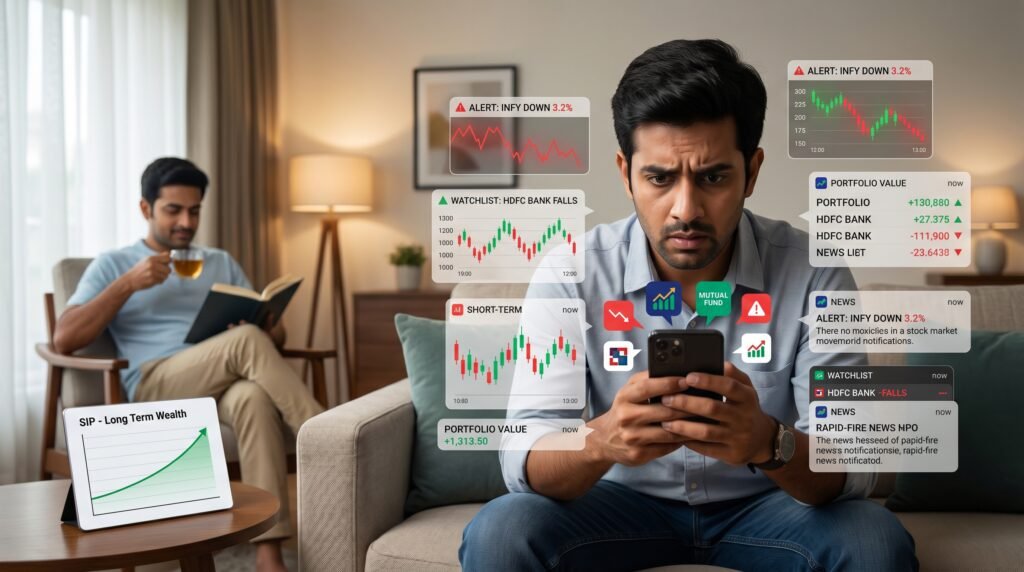
Rohit had fourteen financial apps on his phone. He had price alerts set for every stock in his portfolio, triggering at 0.5% movements in either direction. He checked his portfolio before brushing his teeth in the morning and after his last meeting at night. During weekends, he read quarterly results, watched analyst commentary, and refreshed news feeds.
He also traded, on average, three times a week. Selling when things fell, re-buying when they recovered, switching between funds based on short-term performance. He spent more time on his portfolio than on anything else in his financial life.
His 3-year CAGR: 7.2%.
His colleague Ratan, who set up a structured SIP plan with a financial planner three years ago and genuinely forgot about it, checked his portfolio for the first time when Rohit asked him about it. His 3-year CAGR: 14.6%.
The Monitoring Paradox
The relationship between portfolio monitoring frequency and investment returns is well-documented — and it is inverse. The more often you check, the more likely you are to react to noise. The more you react to noise, the worse your returns.
Markets move constantly, and most of those movements are meaningless. A 1% fall in a day is statistically irrelevant over a 10-year investment horizon. But to a human brain watching it in real time, it feels urgent, dangerous, and actionable.
The DALBAR data quantifies this behavioural gap. The average investor consistently earns 3-5% less per year than the funds they invest in — purely because they react to short-term movements that don’t warrant a response.
Transaction Costs and Taxes
Hyperactive monitoring also leads to hyperactive trading, which has hard costs. Every time you exit an equity investment within 12 months, you pay short-term capital gains tax on the gains. Every unnecessary transaction chips away at returns through brokerage charges and taxes. Rohit’s 7.2% return wasn’t just the result of bad decisions — it was also partially consumed by the friction costs of too many decisions.
What Munger Knew
Charlie Munger was famous for sitting on positions for decades without blinking. He understood that the market’s short-term volatility was not information — it was noise. The actual information — whether a business was growing, compounding, creating value — revealed itself over years, not hours. His philosophy was that the appropriate response to most market movements is to do nothing.
The Right Monitoring Frequency
For an investor with a long-term horizon, checking your portfolio once a quarter is more than sufficient. An annual review with your financial planner — to ensure your asset allocation hasn’t drifted and your goals are still on track — is good practice. Other than that, the best thing you can do for your returns is leave your investments alone.
Rohit deleted four apps last month. He still has ten. Progress is progress.
The Planner Advantage
One of the quietest but most powerful things a financial planner does is reduce the noise in your investing life. When you have a structured plan in place — funds chosen deliberately, goals mapped, review dates scheduled — there is simply less reason to check every day. You know what the plan is. You know when it will be reviewed. You know who to call if something feels wrong. That structure removes the anxiety that drives hyperactive monitoring in the first place. Rohit’s problem wasn’t the apps on his phone. It was the absence of a plan that made every price movement feel like a decision he needed to make.