

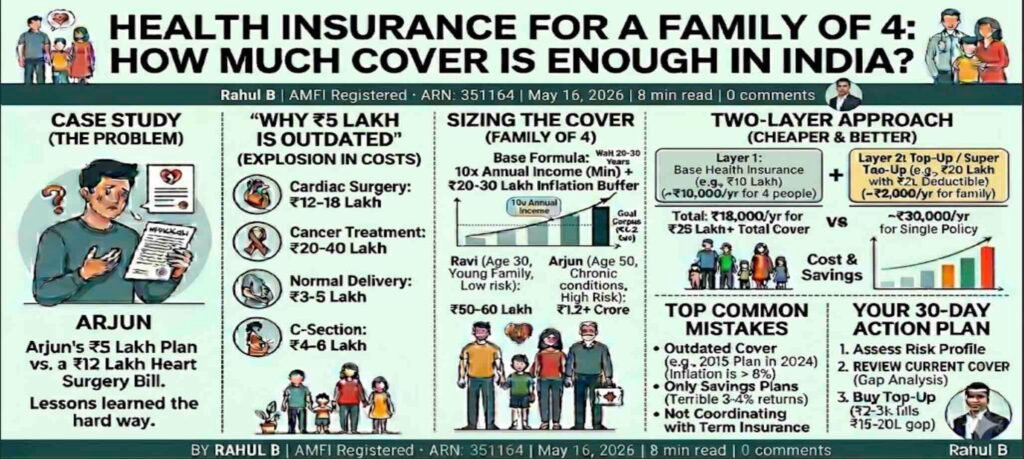
Arjun’s wife woke him up at 2 AM. “My chest feels tight.”
48 hours later, the hospital bill arrived: ₹12 lakhs for a heart surgery.
Arjun had health insurance. ₹5 lakh cover. The insurance paid ₹5 lakhs. Arjun paid ₹7 lakhs from his pocket. He borrowed ₹3 lakhs from his brother. Paid ₹4 lakhs from his savings. The family savings, built over 10 years, was gone in one surgery.
The worst part? He thought ₹5 lakh was enough. Everyone he knew had ₹5 lakh cover. His agent had recommended ₹5 lakh. So ₹5 lakh it was.
Two years later, he’d corrected the gap. But the damage was done. The lesson was learned the hard way: **₹5 lakh cover in 2024 is not enough for an Indian family of 4.**
This post will tell you exactly how much you need—and more importantly, why.
Why Health Insurance Sizing is Different in India
Health costs have exploded. In 2010, a good hospitalization cost ₹2-5 lakhs. Today, it’s ₹10-25 lakhs for serious procedures.
A cancer treatment? ₹20-50 lakhs.
A cardiac surgery? ₹10-15 lakhs.
A major accident? ₹15-30 lakhs.
Most Indians have a 10-year-old mental model of health costs. They buy ₹5 lakh cover and feel safe.
But they’re not. They’re just unaware of the gap.
Let me show you the actual costs.
Real Health Costs in India (2024)
| Procedure | Cost (Private Hospital) | Cost (Super Specialty) |
| Normal delivery | ₹1.5-3 lakh | ₹3-5 lakh |
| C-section | ₹2.5-4 lakh | ₹4-6 lakh |
| Appendectomy | ₹1.5-3 lakh | ₹3-5 lakh |
| Hernia surgery | ₹1-2 lakh | ₹2-3 lakh |
| Cataract surgery | ₹50k-1.5 lakh | ₹1.5-3 lakh |
| Knee replacement | ₹3-5 lakh | ₹5-8 lakh |
| Hysterectomy | ₹2-4 lakh | ₹4-6 lakh |
| Angiography + Stent | ₹3-5 lakh | ₹5-8 lakh |
| CABG (Bypass) | ₹8-12 lakh | ₹12-18 lakh |
| Cancer – Chemotherapy (6 months) | ₹10-20 lakh | ₹20-40 lakh |
| ICU stay (per day) | ₹10-20k | ₹20-50k |
One serious illness = ₹10-30 lakhs in a good private hospital.
If you have ₹5 lakh cover, you’re ₹5-25 lakhs short.
The Right Formula for Family Health Insurance
Here’s how to size health insurance for a family of 4:
Step 1: Assess Your Risk Profile
Age Profile:
– Younger family (all < 40): Lower risk
– Middle-aged (40-50): Moderate risk
– Senior members (60+): High risk
Health History:
– No serious illnesses: Low risk
– Diabetes, BP, etc.: Moderate risk
– Cancer history, multiple surgeries: High risk
Lifestyle:
– Sedentary, poor nutrition: Higher risk
– Active, healthy habits: Lower risk
Income Level:
– Lower income: Prefer government hospitals, less elaborate care
– Middle income: Mix of private and government
– High income: Always private, super specialty
Step 2: Base Cover Formula
Base formula: 10x your annual family income (minimum)
For a family earning ₹60 lakh/year (₹5 lakh/month):
– Base cover = ₹60 lakh
For a family earning ₹30 lakh/year (₹2.5 lakh/month):
– Base cover = ₹30 lakh
Why 10x? Because the most serious illnesses (cancer, major surgeries, long ICU stays) can exceed 15-20% of annual income. Adding buffer for multiple illnesses, you need 10x.
Step 3: Adjust for Risk
– **Low risk family**: Base × 0.7 (so 7x income)
– **Moderate risk family**: Base × 1.0 (10x income)
– **High risk family**: Base × 1.5 (15x income)
Step 4: Add Top-Up for Inflation
Health costs inflate at 8-10% annually (faster than general inflation). If you’re buying a 25-year policy, costs will triple.
Add **₹20-30 lakhs extra** to your base to account for inflation and cost escalation.
Real Examples: What Different Families Need
Family 1: Ravi (Age 30, Wife 28, Kids 5 & 2)
– Annual income: ₹50 lakh (₹4.1 lakh/month)
– Risk profile: Low (all healthy, young)
– Preferred hospitals: Good private
– Base cover needed: 50 lakh × 1.0 (moderate = assumes some risk over 20 years)
– **Recommended cover: ₹50-60 lakh**
Family 2: Arjun (Age 50, Wife 48, Both have BP)
– Annual income: ₹72 lakh (₹6 lakh/month)
– Risk profile: High (both have chronic conditions)
– Preferred hospitals: Super specialty
– Base cover needed: 72 lakh × 1.5 = ₹1.08 crore
– Add inflation buffer: +₹25 lakh
– **Recommended cover: ₹1.2+ crore**
Family 3: Priya (Age 60, Spouse 58, Both retired)
– Annual income: ₹20 lakh (₹1.67 lakh/month)
– Risk profile: High (age 60+)
– Preferred hospitals: Good private + government
– Base cover needed: 20 lakh × 1.5 = ₹30 lakh
– Add inflation buffer: +₹10 lakh
– **Recommended cover: ₹40 lakh minimum**
Family 4: Deepak (Self-employed, Wife, 1 Kid, Age 45)
– Annual income: Variable, average ₹40 lakh
– Risk profile: Moderate to High (self-employed, age 45)
– Preferred hospitals: Good private
– Base cover needed: 40 lakh × 1.2 = ₹48 lakh
– Add inflation + emergency buffer: +₹20 lakh
– **Recommended cover: ₹60+ lakh**
Two-Layer Approach (Best Strategy)
Most financial planners recommend a two-layer approach:
Layer 1: Base Health Insurance (₹5-10 lakh per person)
– Covers routine hospitalizations, surgeries
– Lower deductible
– Easier claims
– Cost: ₹3,000-5,000/person/year
Best options: HDFC ErgoGo, ICICI Lombard Active, Bajaj Allianz HealthGuard
Layer 2: Top-Up / Super Top-Up (₹10-20 lakh)
– Covers serious illnesses, major surgeries
– High deductible (₹1-2 lakh)
– Pays after base insurance is exhausted
– Cost: ₹1,500-3,000/year (very cheap)
How it works:
Cancer treatment = ₹20 lakhs
– Base insurance (₹10 lakh) covers ₹10 lakhs
– Top-up (₹15 lakh with ₹2 lakh deductible) covers remaining ₹8 lakhs
– Family pays: ₹2 lakhs (deductible)
– Total covered: ₹18 lakhs
Two-layer cost for a family of 4:
– Base: ₹4,000 × 4 = ₹16,000/year
– Top-up: ₹2,000 × 1 = ₹2,000/year (family-based)
– **Total: ₹18,000/year for ₹25 lakh+ total cover**
Compare this to:
– Single ₹25 lakh policy: ₹25,000-30,000/year
The two-layer approach is cheaper AND better.
What About Government Insurance (Ayushman Bharat)?
Ayushman Bharat gives ₹5 lakh cover to eligible families (income < certain limit).
Good for: People with low incomes, basic care
Not good for: Super specialty hospitals, choice of hospitals, no waiting
Our recommendation:
– If eligible AND low income: Use Ayushman Bharat as base + buy top-up private cover
– If eligible AND middle+ income: Buy private insurance (Ayushman Bharat limited network)
Common Mistakes in Health Insurance
Mistake 1: Buying Exactly What the Agent Recommends
Agents sell ₹5 lakh because it’s standard. It’s outdated. You need more.
Mistake 2: Not Reviewing Your Cover for 5-10 Years
You bought ₹5 lakh cover in 2015. It’s 2024. Health costs have doubled. You need to review and increase.
Mistake 3: Buying Only Savings Plans
“₹5 lakh cover + maturity benefit of ₹15 lakh” sounds good. But maturity benefits are poor returns (3-4%), and it increases your premium 5x.
Buy pure term health insurance. Invest separately.
Mistake 4: Not Coordinating with Term Insurance
You have ₹1 crore term insurance (death protection). But if you’re alive but seriously ill, you need health insurance. Both are necessary.
Mistake 5: Waiting Until You’re Old
At 60, a ₹15 lakh cover policy costs ₹20,000/year. At 40, the same cover costs ₹5,000/year. Buy health insurance while you’re young.
What to Actually Buy (Our Recommendation for Most Families)
For family earning ₹4-6 lakh/month:
Base Insurance (₹10 lakh per person):
– HDFC ErgoGo or ICICI Lombard Active
– ₹3,000-4,000/person/year
– For 4 people: ₹12,000-16,000/year
– Covers routine surgeries, hospitalizations
Top-Up Insurance (₹20 lakh):
– HDFC ErgoGo Top-Up or Max Bupa Super Top-Up
– ₹2,000-3,000/year for whole family
– Deductible: ₹1-2 lakh
– Covers major illnesses
Total annual cost: ₹15,000-20,000
Total cover: ₹40-50 lakh base + ₹20 lakh top-up = ₹60-70 lakh effective
Understanding Deductibles and No-Claim Bonuses
Deductible
The amount you pay before insurance starts paying.
Example: ₹1 lakh deductible, ₹20 lakh surgery
– You pay: ₹1 lakh
– Insurance pays: ₹19 lakh
Lower deductible = Higher premium
Higher deductible = Lower premium
For top-up insurance, higher deductible is fine because your base insurance already covers initial costs.
No-Claim Bonus
If you don’t claim, your cover increases annually.
Example: ₹10 lakh cover with 10% NCB annually
– Year 1: ₹10 lakh
– Year 2 (no claim): ₹11 lakh
– Year 3 (no claim): ₹12.1 lakh
This is valuable. Choose policies with good NCB.
The Planner Advantage
A financial planner does:
1. **Right-sizes your cover** based on income, age, risk, inflation
2. **Recommends base + top-up strategy** (optimal cost)
3. **Coordinates with other insurance** (ensures no gaps)
4. **Reviews annually** (checks if cover is still adequate)
5. **Helps with claims** (navigation when you need it most)
Most people buy insurance alone and hope for the best. Then when they need it, they discover gaps.
—
Your Action Plan (This Month)
1. **List all family members** and their ages
2. **Calculate your annual income**
3. **Assess your risk profile** (low/moderate/high)
4. **Calculate recommended cover** (10x income, adjusted for risk)
5. **Review your current cover** (check existing policies)
6. **Calculate the gap** (need – have)
7. **Get quotes for base + top-up** (don’t buy single high-value policy)
8. **Buy top-up** if you have gaps (costs ₹2-3k, fills ₹15-20 lakh gap)
This month, just get the coverage right. Next month, we’ll talk about claims and exclusions.
—
Key Takeaways
– **₹5 lakh cover is not enough for a family of 4 in 2024.** You need ₹40-60 lakh minimum.
– **Formula: 10x annual income + inflation buffer.** Adjust for age and risk.
– **Two-layer approach (base + top-up) is cheaper than single high-value policy.** Same cover, lower premium.
– **Review your cover every 2-3 years.** Health costs inflate faster than general inflation.
– **Buy pure health insurance, not savings plans.** Savings plans have terrible returns.
—
Disclaimer
This article is for educational purposes only. Your specific cover needs may differ based on personal circumstances, existing coverage, and geographic location. Consult a certified health insurance advisor before making changes.
Rahul Bhaskar | AMFI ARN: 351164 | [rahulmoney.com](https://rahulmoney.com)
*Need help sizing health insurance for your family? Let’s review your current cover together.*