

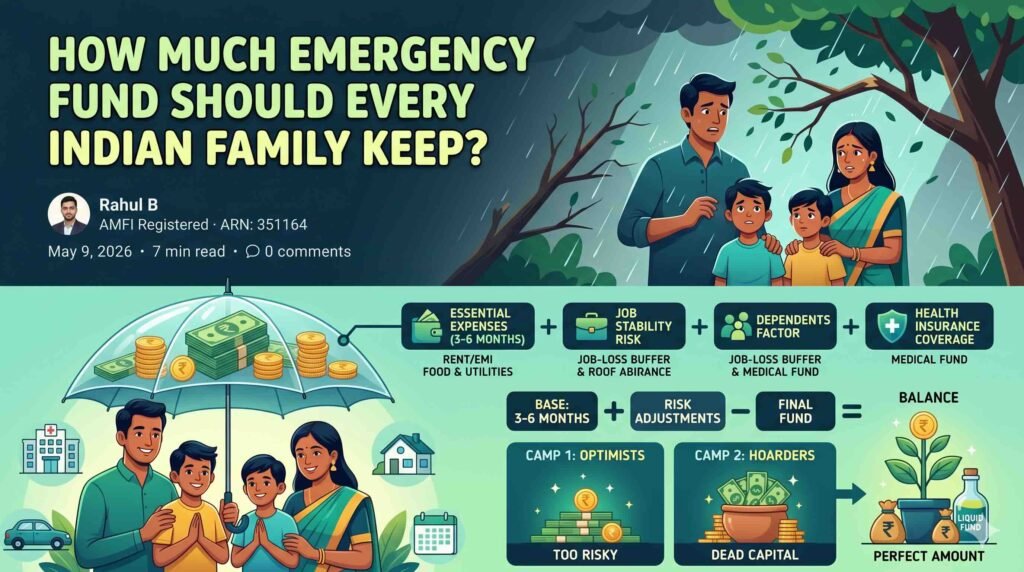
Priya’s world fell apart on a Tuesday afternoon.
Her father had a heart attack. The hospital bill came to ₹8 lakhs. Her mother was too shocked to work. Her brother was between jobs. The family had ₹1 lakh in savings—meant for her wedding next year.
They borrowed from relatives. Took a loan. Sold her mother’s gold. All because no one had asked the simple question: **”What if something goes wrong?”**
Three years later, after her father recovered, Priya asked me: “How much should we have had saved?”
This post answers that question—because it’s not one number. It’s a formula.
Why Most Indians Get Emergency Funds Wrong
People fall into two camps:
Camp 1: The Optimists
“Nothing will happen to me. Why keep money idle? I’ll invest it.”
They have ₹10,000 emergency fund. Then life happens. Boom.
Camp 2: The Hoarders
“I need to be safe. I’ll keep ₹50 lakhs.”
Now they have ₹50 lakhs sitting in a savings account earning 3% interest. That money could’ve been compounding at 12% in mutual funds.
Both are wrong.
The right answer depends on four things:
1. Your monthly expenses
2. Your job stability
3. Your dependents
4. Your health & insurance coverage
Let’s build your formula.
The Base Formula: 3-6 Months of Expenses
You’ve probably heard this. It’s popular because it works—mostly.
Your emergency fund should cover 3-6 months of essential expenses.
Not total expenses. **Essential** expenses.
What’s “Essential”?
Go back to our salary split article. Remember that ₹30,000/month for essentials?
– Rent/EMI
– Utilities
– Food
– Transport
– Insurance premiums
– Medicines/healthcare
– Debt repayment (if any)
That’s your essential number. Everything else (Netflix, eating out, hobbies) is not essential in an emergency.
The Math
For Priya’s family (₹60,000/month salary):
Essential monthly expenses = ₹36,000
– Rent: ₹15,000
– Food: ₹8,000
– Utilities: ₹2,000
– Transport: ₹2,000
– Insurance: ₹4,000
– Medical/meds: ₹2,000
– Loan repayment: ₹3,000
Minimum emergency fund: 3 months = ₹36,000 × 3 = ₹1,08,000
Ideal emergency fund: 6 months = ₹36,000 × 6 = ₹2,16,000
So Priya should have ₹1-2 lakhs. She had ₹1 lakh. Close, but not enough when the emergency included ₹8 lakhs medical bill.
But Your Emergency Fund Formula Needs Adjustments
The 3-6 month rule is a starting point. Your real number depends on **risk factors**.
Risk Factor 1: Job Stability
Stable job (government employee, large established company): 3 months
Moderate stability (mid-size company, regular contract work): 4-5 months
High turnover industry (startups, freelance, commission-based): 6-9 months
Why? If you lose your job, how long to find another? Government employee? 6 months is fine. Startup employee? You might be job-hunting for 9 months.
Risk Factor 2: Dependents
No dependents (single, no one relies on you): 3 months
1-2 dependents (spouse, 1-2 kids, maybe aging parent): 6 months
3+ dependents (larger family, aging parents, extended family): 9 months
Why? More people = more expenses. An ₹8 lakh medical emergency hits harder when you’re supporting 5 people instead of 1.
Risk Factor 3: Health & Insurance Coverage
Good health insurance (₹10 lakh+ family cover, annual health checkup): 3 months
Basic health insurance (₹5 lakh cover): 4-5 months
No health insurance: 6-9 months + separate medical fund
Why? An uninsured medical emergency can blow through a year’s salary. Priya’s father’s ₹8 lakh bill became manageable because the insurance covered ₹5 lakhs. If they’d had ₹0 insurance, they’d need ₹10+ lakhs emergency fund.
Risk Factor 4: Income Stability (Self-Employed & Freelancers)
If you’re self-employed (like I am as an MFD), your emergency fund needs are different.
Established self-employed (3+ years, consistent income): 6-9 months
New self-employed (0-2 years): 12+ months
Why? Your income fluctuates. You might earn ₹1 lakh one month, ₹50k the next. You need enough to weather the slow months.
Real Examples: What Different Families Need
Example 1: Ravi (Single, Salaried, Good Health Insurance)
– Monthly essentials: ₹25,000
– Job stability: High (tech company)
– Dependents: 0
– Health insurance: ₹10 lakh cover
Formula: 25,000 × 3 = ₹75,000
Ravi needs a minimum of ₹75,000. But let’s round it up to **₹1 lakh** for comfort.
Example 2: Priya (Married, 1 Kid, Salaried, Basic Insurance)
– Monthly essentials: ₹40,000
– Job stability: Moderate (mid-size company, can change jobs)
– Dependents: 2 (husband & daughter)
– Health insurance: ₹5 lakh cover
Formula: 40,000 × 6 = ₹2,40,000
Priya needs **₹2-2.5 lakhs**. She had ₹1 lakh, which was why the ₹8 lakh bill hurt so badly.
Example 3: Arjun (Self-Employed, Married, 2 Kids, No Health Insurance)
– Monthly essentials: ₹45,000
– Job stability: Low (freelance income varies)
– Dependents: 3 (wife, 2 kids)
– Health insurance: None
Formula: 45,000 × 9 = ₹4,05,000 (minimum)
Plus medical buffer: +₹3 lakhs (since no insurance)
Arjun needs **₹7 lakhs minimum**. And honestly? Get health insurance first. That alone brings the emergency fund need down.
Where to Keep Your Emergency Fund
This matters. A lot.
Wrong places:
– Savings account (3% interest, too easy to access, gets spent)
– Fixed Deposit (locked for 1 year, what if you need it on day 200?)
– Mutual funds (10% sudden drop when you need it, tax on withdrawal)
Right places:
1. **Liquid Funds (Best Option)**
– Returns: 4.5-5.5% annually
– Accessibility: 1-2 days to withdraw
– Safety: 100% safe (MF backed by short-term bonds)
– Taxation: Treated as income (better than FD for <3 years)
– **Best for**: ₹50k-₹5 lakh emergency fund
Top options: Liquid funds from Axis, HDFC, ICICI, UTI
2. **Bank Savings Account (First ₹20-30k)**
– Returns: 2-3%
– Accessibility: Instant
– Safety: DICL insured up to ₹10 lakh
– **Best for**: Quick access money, the “panic fund”
3. **Money Market Fund / Ultra-Short Duration Fund (Growing trend)**
– Returns: 5-6%
– Accessibility: 1-2 days
– Safety: Safe
– **Best for**: If you want better returns than liquid funds with same accessibility
4. **High-Yield Savings Account (New banks)**
– Returns: 4-5%
– Accessibility: Instant
– Safety: DICL insured
– **Best for**: If you find one that’s reliable
Priya’s setup now:
– ₹30,000 in bank savings (instant access, panic fund)
– ₹2 lakh in Axis Liquid Fund (safe, accessible, earning 5%)
– Total emergency fund: ₹2,30,000
The Emergency Fund Shouldn’t Be a Dead Weight
Here’s what people get wrong: **Your emergency fund isn’t meant to stay static.**
Year 1: Build it to 3 months
Year 2: Grow it to 6 months
Year 3+: Let it grow. Every 2-3 years, you’ll re-evaluate and increase it.
Why? Because your salary increases. Your essential expenses increase. Your emergency fund should scale up too.
The rule: Every salary increase, increase your emergency fund by 30%.
If Ravi got a ₹5,000 raise, he’d increase his emergency fund from ₹1 lakh to ₹1.5 lakh (not spend it all on wants).
What Counts as Using Your Emergency Fund?
Do use it for:
– Job loss (living expenses while job hunting)
– Medical emergency not covered by insurance
– Home emergency (roof repair, plumbing burst)
– Car repair (if your car is essential for work)
– Death in family (travel, ceremonies)
Don’t use it for:
– Vacation (savings, not emergency fund)
– Shopping season / Diwali (separate fund)
– Car upgrade (savings)
– Friend’s loan request (this comes from wants)
The rule: If you had 6 months notice, would you need emergency funds? If yes, it’s an emergency. If you can plan for it, it’s not.
The Planner Advantage
Here’s what a financial planner does for emergency fund planning:
1. **Sizes it correctly** based on your specific life (not generic formulas)
2. **Allocates it optimally** (emergency fund + health insurance + savings rate)
3. **Monitors it** (tells you when to increase it, where to move it)
4. **Integrates it with other plans** (e.g., when you have ₹2 lakhs, should it be emergency fund or down payment on a home?)
Priya worked with a planner after her father’s health scare. The planner said: “Your emergency fund was okay for job loss. But it wasn’t sized for medical emergencies. We need to add health insurance + increase this to ₹2.5 lakhs.”
One conversation. Saved her family from future crises.
—
Your Action Plan (This Month)
1. **Calculate your essential expenses** (rent, food, utilities, insurance, medicines, debt)
2. **Assess your risk factors** (job stability, dependents, health insurance)
3. **Apply the formula**: 3-6 months of essentials × risk adjustment (1.0 to 3.0x)
4. **Set a target**: (e.g., ₹1.5 lakhs)
5. **Choose a home**: Liquid fund + savings account split
6. **Automate it**: Transfer ₹5,000/month to your emergency fund until you hit the target
Once you hit the target, you can stop and redirect that money to investments. But for now? **Emergency fund first, wealth second.**
—
Key Takeaways
– **The 3-6 month rule is a starting point, not the answer.** Adjust for your job stability, dependents, and health insurance.
– **Essential expenses, not total expenses.** Don’t count Netflix and dining out.
– **Liquid funds are your best friend.** 4.5-5.5% returns with instant accessibility.
– **Your emergency fund should grow with your salary.** Don’t leave it at ₹1 lakh forever.
– **Health insurance makes emergency funds smaller.** Get insured before you get sick.
—
Disclaimer
This article is for educational purposes only and does not constitute financial advice. Consult a certified financial planner to size your emergency fund based on your personal circumstances.
Rahul Bhaskar | AMFI ARN: 351164 | [rahulmoney.com](https://rahulmoney.com)
*Need help building an emergency fund that actually protects your family? Let’s talk.*