

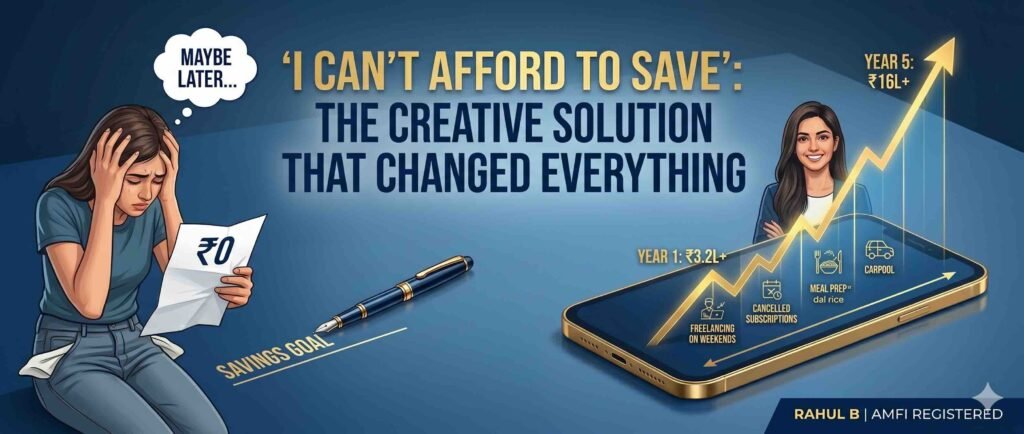
Priya sat at her kitchen table, staring at her bank statement.
Income: ₹58,000/month Rent: ₹18,000 Groceries: ₹7,000 EMI (bike loan): ₹4,500 Internet + Phone: ₹1,800 Parents (monthly support): ₹10,000 Utilities: ₹2,500 Transport: ₹3,000 Miscellaneous: ₹8,200
Balance: ₹3,000
She wanted to start investing. Everyone around her was talking about SIPs, compounding, building wealth.
But the math was brutal. After all expenses, she had ₹3,000 left. That was her emergency buffer. She couldn’t invest it.
I just don’t earn enough, she thought. Maybe in a few years, after a promotion or two, I’ll be able to save properly.
Her friend Rekha texted: “Did you start that SIP yet?”
Priya replied: “I can’t afford to. There’s nothing left after expenses.”
Rekha called immediately.
“Nothing left?” she asked.
“₹3,000,” Priya said. “But I need that for emergencies.”
“Okay,” Rekha said. “Let me ask you something. How much do you spend on Swiggy and Zomato?”
Priya paused. “I don’t know. Maybe ₹4,000?”
“And subscriptions? Netflix, Prime, Spotify?”
“₹1,500 total.”
“So that’s ₹5,500 right there,” Rekha said. “Not saying you should cut everything. But what if you cut ₹3,000 of that? Would you die?”
Priya laughed. “No, I wouldn’t die.”
“Then you can afford to save. You’re just choosing not to.”
—
The Creativity Gap
David Schwartz writes in The Magic of Thinking Big:
“When you believe something is impossible, your mind stops looking for solutions. When you believe it’s possible, your mind finds a way.”
The problem isn’t that Priya couldn’t afford to save.
The problem was she’d labeled it “impossible,” so her brain stopped searching for creative solutions.
“I can’t afford to save” is lazy thinking. It’s a dead-end statement.
Creative thinking asks better questions:
Not: “Can I afford to save?” But: “How can I afford to save?”
Not: “I don’t have enough left.” But: “Where can I find more?”
Not: “My expenses are fixed.” But: “Which expenses can I challenge?”
The shift from “can’t” to “how” unlocks creativity.
—
Priya’s Creativity Experiment
After that call with Rekha, Priya decided to try something.
For one month, she’d track every rupee she spent. Not to judge herself, but to understand where the money was actually going.
She used a simple expense tracker app. Every chai, every auto ride, every impulse Amazon order—logged.
At the end of the month, she had her answer.
**The Breakdown:**
Category: Food Delivery (₹4,800) – 16 orders averaging ₹300 each – Mostly dinner (too tired to cook after work)
Category: Subscriptions (₹1,650) – Netflix: ₹649 – Amazon Prime: ₹459 – Spotify: ₹119 – Hotstar: ₹299 – A meditation app she’d used twice: ₹124
Category: Impulse Shopping (₹3,200) – Clothes she didn’t need: ₹1,800 – Books she hadn’t read: ₹650 – Random gadgets: ₹750
Category: Miscellaneous Wastage (₹2,100) – Coffee shop visits (not for meetings, just boredom): ₹1,400 – Late-night snacks from the corner store: ₹700
Total Identified Waste: ₹11,750
Priya stared at the number.
₹11,750.
She’d been telling herself “I can’t afford to save,” while spending nearly ₹12,000 on things that didn’t matter.
She didn’t need to earn more. She needed to spend smarter.
—
The Creative Solutions
Priya didn’t want to become a minimalist monk. She wanted to live well and invest.
So she got creative.
**Solution 1: Meal Prep Sundays**
Instead of ordering food 16 times a month, she started cooking in bulk on Sundays.
– Made enough dal, rice, and sabzi for 4 dinners – Stored in glass containers – Reheated after work
Cost of groceries for meal prep: ₹1,200 Saved on food delivery: ₹3,600/month
Found: ₹2,400
**Solution 2: Subscription Audit**
She canceled: – Hotstar (could watch free content elsewhere) – The meditation app (YouTube had free meditation videos)
She kept Netflix and shared the cost with her roommate (₹325 each).
Found: ₹750
**Solution 3: The 48-Hour Rule**
Every time she wanted to buy something online, she added it to a wishlist and waited 48 hours.
If she still wanted it after two days, she’d buy it. If not, it was an impulse.
Result: 70% of her “wants” disappeared after 48 hours.
Impulse shopping dropped from ₹3,200 to ₹800.
Found: ₹2,400
**Solution 4: Coffee at Home**
Priya loved coffee. But ₹150 lattes at Starbucks 3 times a week added up.
She bought a French press (₹800 one-time cost) and good coffee beans (₹400/month).
Home coffee cost: ₹400/month Starbucks cost: ₹1,800/month
Found: ₹1,400
**Solution 5: Weekend Freelance**
Priya was a content writer. She reached out to two startups and offered to write blog posts on weekends.
Rate: ₹2,000 per article Output: 2 articles/month (4 hours of work)
Found: ₹4,000
**Total Found: ₹11,000/month**
Priya didn’t earn a single rupee more from her job. But by getting creative, she found ₹11,000 that was disappearing into the void.
She started a ₹10,000/month SIP immediately.
—
Creative Thinking Principle #1: Addition by Subtraction
Schwartz observed: “Most people try to solve problems by adding. Creative thinkers solve problems by subtracting.”
When Priya thought “I need to save ₹10,000,” her first instinct was: I need to earn ₹10,000 more.
But creative thinking flipped it: What if I stopped spending ₹10,000 on things I don’t need?
Addition by subtraction.
You don’t need a raise to start investing. You need to stop leaking money.
—
Creative Thinking Principle #2: Challenge Every “Fixed” Expense
Most people have a mental list of “fixed” expenses—things they believe can’t be changed.
Rent. Groceries. Phone bill. EMI.
But “fixed” is often just “unquestioned.”
Priya challenged every line item:
Rent (₹18,000): Could she get a roommate and split it? Move closer to work and save on transport?
Groceries (₹7,000): Was she buying premium brands when generic would do? Throwing away vegetables that spoiled?
Phone bill (₹900): Did she need unlimited data, or was 2GB enough?
After the audit, she: – Got a roommate (rent dropped to ₹9,000) – Switched to a cheaper phone plan (₹900 → ₹500)
Found: ₹9,400 more per month
Now she was investing ₹10,000 and had ₹8,000 left over for guilt-free spending.
—
Creative Thinking Principle #3: Earn More *and* Save More
Priya’s weekend freelancing was the game-changer.
Most people think: I’ll save what’s left after expenses.
Creative thinkers flip it: I’ll create new income streams dedicated entirely to investing.
Priya’s freelance income (₹4,000/month) didn’t touch her regular budget. It went straight to her SIP.
By Year 2, she’d built the freelance side hustle to ₹8,000/month. Her SIP was now ₹18,000/month.
Same job. Same base salary. But creative income allocation.
—
The Results: 18 Months Later
Month 1 (Pre-Creativity): – Savings: ₹0 – Investments: ₹0 – Excuse: “I can’t afford it.”
Month 18 (Post-Creativity): – Monthly SIP: ₹10,000 (from primary income) + ₹6,000 (from freelancing) = ₹16,000 – Portfolio value: ₹3.2 lakhs – Contributions: ₹2.88 lakhs – Gains: ₹32,000
Priya hadn’t gotten a promotion. Her salary was still ₹58,000.
But she’d gone from “I can’t afford to save” to building a ₹3.2 lakh portfolio—by thinking creatively.
—
Five Creative Money Questions to Ask Right Now
If you’re stuck thinking “I can’t afford to save,” try these:
**Question 1: Where is my money leaking?**
Track expenses for 30 days. Find the leaks. Cut 30% of waste.
**Question 2: What can I do once that saves me money forever?**
Examples: – Cancel unused subscriptions (saves ₹500-1,500/month forever) – Learn to cook one meal (saves ₹3,000/month forever) – Switch to a cheaper phone plan (saves ₹300/month forever)
**Question 3: Can I split, share, or negotiate this cost?**
– Split Netflix with a friend – Negotiate rent with your landlord – Share ride costs with a colleague
**Question 4: What skill do I have that someone will pay for?**
Writing? Design? Tutoring? Coding?
Freelance platforms: Upwork, Fiverr, Topmate, Internshala
Even ₹3,000/month side income = ₹36,000/year = ₹3.6 lakhs in 10 years (at 12% CAGR).
**Question 5: What would I do if I *had* to find ₹5,000 this month?**
If your life depended on it, you’d find a way.
The creativity is already there. You just need urgency to unlock it.
—
From “I Can’t” to “I Did”
Two years after that conversation with Rekha, Priya was having chai with a colleague who said:
“I wish I could invest like you, but I just don’t have the money.”
Priya smiled. “That’s what I used to say.”
“So what changed?”
“I stopped asking ‘Can I afford to save?’ and started asking ‘How can I afford to save?’ The first question shuts your brain down. The second one wakes it up.”
Her colleague nodded slowly. “So you’re saying I’m just being lazy?”
“Not lazy,” Priya said. “Just uncreative. But creativity is a muscle. You build it by using it.”
—
The Creative Mindset Schwartz Taught
Here’s what Schwartz understood:
Problems don’t have one solution. They have ten. But you’ll only find them if you believe they exist.
“I can’t afford to save” is a statement. It closes the door.
“How can I afford to save?” is a question. It opens ten doors.
Behind Door 1: Cut food delivery expenses. Behind Door 2: Cancel subscriptions. Behind Door 3: Freelance on weekends. Behind Door 4: Get a roommate. Behind Door 5: Negotiate bills.
Every door leads somewhere. But you’ll never open them if you’re convinced they don’t exist.
—
Next in the series: Are You a Saver or an Investor? Why Your Money Identity Determines Your Net Worth
—
Disclaimer: This article is for educational purposes only. Mutual fund investments are subject to market risks. Please read all scheme-related documents carefully before investing. The author is a SEBI-registered Mutual Fund Distributor (ARN 351164). Past performance is not indicative of future returns.