

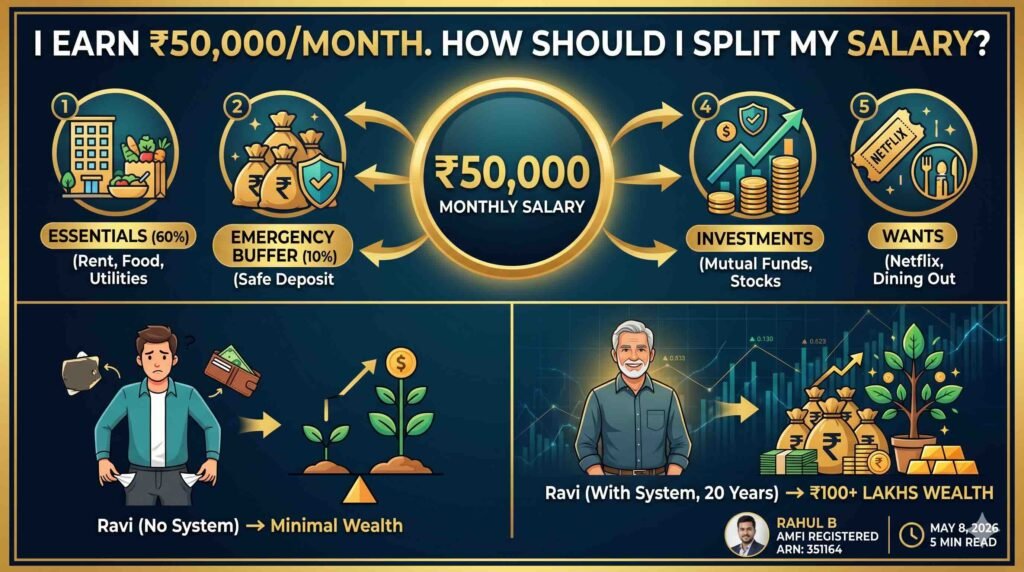
Meet Ravi. He’s 28, works as a junior manager at a mid-size tech company, and takes home ₹50,000 every month. Last week, his friend Arjun asked him: “Ravi, you make good money. Why aren’t you richer?”
That question kept him awake.
The truth? Ravi had no system. Money came in, money went out, and at the end of the month, his savings account looked almost empty. He wasn’t bad with money—he just didn’t have a **structure**.
If you’re earning ₹50,000/month (or close to it), this post is for you. Let’s build that structure.
The 50/30/20 Rule (And Why It Doesn’t Work In India)
You’ve probably heard of the 50/30/20 rule: 50% needs, 30% wants, 20% savings. It’s popular, it’s simple, and it’s **completely useless for most Indians**.
Why? Because rent alone eats 40-50% of a ₹50k salary in most Indian cities. Add utilities, groceries, and basic transport, and you’re already past 60%. The math breaks.
We need an **Indian salary split**.
The ₹50,000/Month Breakdown (What Actually Works)
Here’s a realistic split for someone earning ₹50,000/month in India:
1. **Essentials: ₹30,000 (60%)**
These are non-negotiable expenses:
– Rent/EMI: ₹15,000-18,000
– Utilities (electricity, water, internet): ₹2,000-3,000
– Groceries & food: ₹6,000-7,000
– Transport/petrol: ₹2,000-3,000
– Phone/subscriptions: ₹1,000
Why 60% instead of 50%? Because Indian housing is expensive, and it’s okay to acknowledge that reality.
2. **Emergency Buffer: ₹5,000 (10%)**
This goes to your emergency fund account—separate, untouched, growing every month. We’ll talk more about how much you actually need, but this ₹5,000/month is non-negotiable.
3. **Insurance & Long-Term Security: ₹5,000 (10%)**
This is where Ravi made his biggest mistake. He had zero insurance.
– Term life insurance: ₹500-800/month (₹1 crore cover, age 28)
– Health insurance: ₹2,500-3,000/month (top-up cover)
– Other: ₹1,500-2,000
You might think, “I’m young, why insurance?” The answer: because you’re young. Insurance is **cheapest when you’re healthy**. By age 35, the same cover costs 3x more.
4. **Investments for Wealth: ₹7,000 (14%)**
Now the fun part—building your future.
– SIP in mutual funds: ₹4,000-5,000/month
– Direct stocks (if you’re interested): ₹1,000-2,000/month
– Savings account/FDs: ₹1,000
Mutual fund SIPs are your best friend here. A ₹4,000/month SIP in a good flexi-cap fund at 12% returns grows to ₹1 crore in 20 years.
5. **Wants & Enjoyment: ₹3,000 (6%)**
Netflix, dining out, movies, hobbies—whatever makes you happy.
Total: ₹50,000
What This Looks Like (Ravi’s Real Budget)
Category | Amount | % |
Essentials | ₹30,000 | 60% |
Emergency Buffer | ₹5,000 | 10% |
Insurance | ₹5,000 | 10% |
Investments | ₹7,000 | 14% |
Wants | ₹3,000 | 6% |
**Total** | **₹50,000** | **100%** |
When Ravi saw this breakdown, he said: “But that leaves me only ₹3,000 for enjoying life!”
Exactly. That’s the conversation you need to have with yourself. **Every rupee you earn makes a choice: build your future or enjoy today?** Most people choose both poorly. Ravi chose both well.
The Power of This Split Over 20 Years
Let’s fast-forward. Ravi is 48. He’s been following this split for 20 years.
– **Emergency fund**: ₹12 lakhs (₹5,000 × 12 × 20 = stable, grows with interest)
– **Investments**: At 12% returns, ₹7,000/month SIP = ₹45 lakhs
– **Insurance payouts saved**: ₹60 lakhs (term insurance actually **returned** his premiums if he lived past 50)
– **Wealth created**: ₹100+ lakhs, mostly passive
Compare that to Ravi’s friend who spent all ₹3,000/month on wants. He has ₹0 to show.
Common Mistakes People Make
Mistake 1: Investing before insurance
Your family is your best investment. Protect it first.
Mistake 2: Setting the same budget for everyone
If you have a ₹50k salary but live in Bangalore vs. Indore, your essentials budget will differ. Adjust accordingly.
Mistake 3: Keeping savings in “safe” accounts
Your ₹5,000/month emergency fund shouldn’t sit in a 3% savings account. Use a good liquid fund (4.5-5% returns) or a dedicated emergency fund account.
Mistake 4: Never revisiting this split
Get a promotion? Salary increase? Don’t just spend it. Use the 50/30/20 principle on the **new amount**. If you go from ₹50k to ₹70k, that extra ₹20k should go: ₹10k to investments, ₹5k to insurance/long-term, ₹5k to wants.
A Word on Working With a Financial Planner
Here’s what Ravi learned: **having a system beats having a high salary.**
He knows this because his friend Priya earns ₹45,000/month but is richer than him. Why? Because she worked with a financial planner who:
– Optimized her insurance mix (saved ₹2,000/month)
– Recommended the right mutual funds (earning 15% vs. his 11%)
– Built a tax-efficient investment strategy
Ravi didn’t need someone to tell him what to spend. He needed someone to ensure his money worked harder.
—
Your Action Plan (This Week)
1. **Write down your salary**: ₹50k? ₹60k? More?
2. **List all your essentials**: Rent, food, transport, bills (don’t estimate—check your last 3 months)
3. **Apply the split**: 60% essentials, 10% emergency, 10% insurance, 14% investments, 6% wants
4. **Adjust for your reality**: If your essentials are 70%, reduce wants, not investment
5. **Open separate accounts**: Checking (essentials), Savings (emergency fund), Investment (SIP, stocks)
This week, just create the structure. Next week, we’ll talk about **what to invest in**.
—
Key Takeaways
– **₹50,000/month isn’t a small salary—it’s a big opportunity.** But only if you have a system.
– **The 50/30/20 rule doesn’t work in India.** Use 60/10/10/14/6 instead.
– **Insurance comes before investing.** Your family’s protection is more valuable than any mutual fund.
– **Consistency beats complexity.** A ₹7,000/month SIP for 20 years beats trying to time the market.
– **Your salary increases with years. Your system should too.** Don’t let lifestyle inflation eat your raises.
—
Disclaimer
This article is for educational purposes only and does not constitute financial advice. Your personal situation—liabilities, goals, risk tolerance—may differ. Please consult a certified financial planner before making investment decisions.
Rahul Bhaskar | AMFI ARN: 351164 | [rahulmoney.com](https://rahulmoney.com)
*Want personalized guidance on your ₹50,000 salary? Let’s talk. I help salaried professionals in India build wealth without complexity.*