

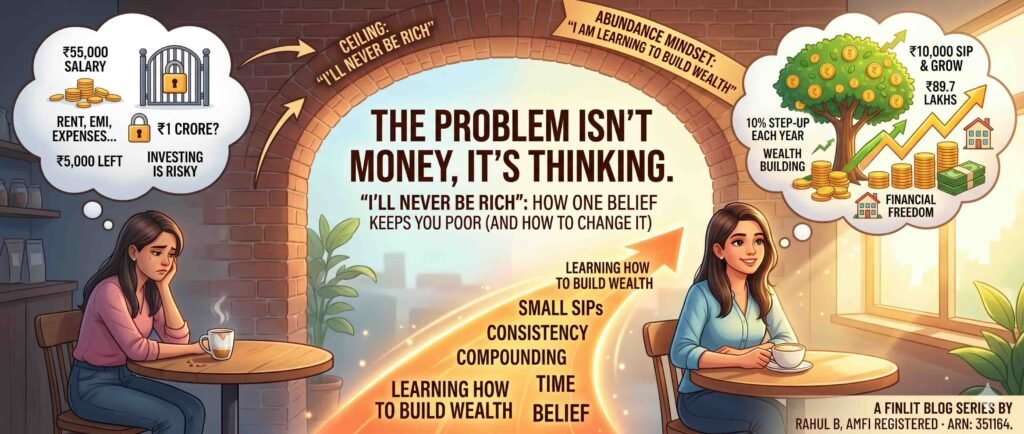
Priya was 28 years old when she said it out loud for the first time.
“I’ll never be rich.”
She wasn’t being dramatic. She wasn’t looking for sympathy. She was just stating what felt like a fact—the same way you’d say “I’ll never be 6 feet tall” or “I’ll never run a marathon.”
It happened during a conversation with her cousin Rekha, who had just bought her second property—a 2BHK in Whitefield that she was renting out for ₹25,000 a month.
“You should invest too,” Rekha said. “Real estate, mutual funds, something. You’re earning well. Build assets.”
Priya laughed. “I make ₹55,000 a month. After rent, groceries, EMIs, and sending money home, I barely have ₹5,000 left. I’m not in your league.”
“I wasn’t either,” Rekha said. “I started with ₹3,000 a month in SIPs seven years ago.”
Priya shook her head. “That’s different. You’re good with money. I’m not. I’ll never be rich like you.”
Rekha paused. “Do you actually believe that?”
“Of course,” Priya said. “Some people are just wired for wealth. I’m not one of them.”
—
The Most Dangerous Sentence You’ll Ever Say
David Schwartz opens The Magic of Thinking Big with a simple, brutal observation:
“Belief, strong belief, triggers the mind to figure out ways and means and how-to.”
And the reverse is equally true:
Disbelief—the belief that something is impossible—triggers the mind to find reasons why it won’t work.
Priya’s problem wasn’t her ₹55,000 salary. It wasn’t her ₹5,000 surplus. It wasn’t even her lack of financial knowledge.
Her problem was one sentence: “I’ll never be rich.”
That sentence, spoken casually over coffee, was a belief. And beliefs are invisible prisons.
Once you believe something is impossible, your brain stops looking for solutions. It starts collecting evidence to confirm what you already think.
“I’ll never be rich” becomes: – “See? I only have ₹5,000 left this month. Told you.” – “Mutual funds dropped 10% last quarter. Good thing I didn’t invest. I’d have lost money.” – “Rekha got lucky. Real estate was cheaper back then. It’s too late for me.”
Every piece of data gets filtered through the belief. And the belief gets stronger.
—
Where This Belief Comes From
Schwartz argues that disbelief is learned, not innate. Nobody is born thinking “I’ll never be rich.”
So where does it come from?
1. **Childhood Conditioning**
Priya grew up in a middle-class household in Vizag. Her father was a government employee. Her mother was a homemaker. Money was tight, but they managed.
The phrases she heard growing up: – “We’re not like those rich people.” – “Money doesn’t grow on trees.” – “Be grateful for what you have.” – “Don’t take risks. Stick to safe jobs.”
None of these statements are malicious. They’re protective. Her parents were teaching her to be realistic, to manage expectations, to avoid disappointment.
But the unintended side effect? Priya absorbed a belief: Wealth is for other people. Not for us.
2. **Comparison Trap**
Priya scrolled through Instagram and saw friends on foreign vacations, buying cars, posting about their new flats. She compared their highlight reels to her behind-the-scenes struggles and concluded: They have something I don’t.
What she didn’t see: – Rekha’s seven years of disciplined SIPs – Arjun’s two job switches and brutal upskilling grind – Ravi’s side hustle that brought in an extra ₹15,000/month
She saw the results, not the process. And results without context feel like luck.
3. **Fear of Failure**
Priya had tried investing once. She put ₹10,000 into a stock her colleague recommended. Within three months, it dropped to ₹7,500. She panicked and sold.
The lesson her brain filed away? Investing doesn’t work for me. I’m bad with money.
One failure became evidence of permanent inadequacy.
—
The Turning Point: What Changed for Priya
Six months after that conversation with Rekha, Priya was scrolling through LinkedIn when she saw a post by someone she’d gone to college with—Ananya.
Ananya had just hit ₹10 lakhs in her mutual fund portfolio. The post wasn’t a brag. It was a reflection:
“Five years ago, I was broke, confused, and convinced I’d never be rich. Today, I’m not rich—but I’m building wealth. The only thing that changed? I started believing it was possible.”
Priya felt something shift.
Ananya wasn’t special. She didn’t come from money. She didn’t have an MBA from IIM. She was just… someone who believed.
That night, Priya opened her notes app and typed a question Schwartz poses in Chapter 1:
“Do I believe I can succeed?”
Her honest answer: No.
So she asked a follow-up:
“What if I did believe? What would change?”
And for the first time, she let herself imagine.
—
The Experiment: 30 Days of Believing
Priya decided to run an experiment.
For 30 days, she would act as if she believed wealth was possible for her—even though she didn’t fully believe it yet.
Here’s what she did:
Week 1: Change the Story
Every time she caught herself thinking “I’ll never be rich,” she replaced it with:
“I’m learning to build wealth.”
Not “I am rich.” Not even “I will be rich.” Just: I’m learning.
That small shift removed the pressure. She didn’t have to believe in the destination yet—just the process.
Week 2: Prove It’s Possible (On Paper)
Priya opened a SIP calculator and plugged in numbers: – ₹5,000/month – 12% CAGR (historical equity mutual fund average) – 20 years
Result: ₹49.95 lakhs.
She stared at the screen. ₹50 lakhs. From ₹5,000 a month.
Then she adjusted: – ₹7,000/month (if she cut a few subscriptions and ate out less) – Step-up SIP by 10% every year (as her salary grew)
Result: ₹89.7 lakhs. Nearly ₹90 lakhs.
Her brain had been screaming “impossible” for years. But the math didn’t care about her beliefs. The math just… worked.
For the first time, she thought: Maybe it’s not impossible. Maybe I’ve just been thinking too small.
Week 3: Take One Small Action
Belief without action is just daydreaming.
Priya opened her banking app and started a SIP. ₹5,000/month into a flexicap mutual fund.
She didn’t wait for the “perfect” fund. She didn’t wait until she had ₹50,000 saved up first. She didn’t wait for the market to “correct.”
She just started.
And something strange happened: the moment she hit “Confirm,” the belief became a little more real.
Week 4: Surround Herself with Believers
Priya joined an online community of young investors. She listened to a podcast about SIPs. She followed a few finance creators on Instagram who shared their journeys—not just their wins, but their doubts and mistakes too.
Every story reinforced the same message: Ordinary people build wealth. You don’t need to be special. You just need to believe and start.
—
The Results: One Year Later
Twelve months after starting her ₹5,000 SIP, Priya’s portfolio was worth ₹68,400.
Her contributions: ₹60,000. Returns: ₹8,400 (14% gain in a good market year).
Was she rich? No.
But here’s what had changed:
1. She believed it was possible. Not someday. Not for other people. For her.
2. She had proof. Her portfolio wasn’t theoretical anymore. It was real. Growing. Hers.
3. She stepped up her SIP. After a salary hike, she increased it to ₹7,000/month. Then ₹8,500. Now she’s at ₹10,000.
4. She stopped comparing. Rekha’s ₹25 lakh property didn’t make Priya feel inferior anymore. It made her think: If she can, I can too.
By Year 3, Priya’s portfolio crossed ₹2.8 lakhs. By Year 5, she was at ₹6.4 lakhs.
She still wasn’t “rich” by Instagram standards. But she was wealth-building. And the belief that had once felt like a lie—I can build wealth—now felt like the truth.
—
How to Change Your Belief (Even If You Don’t Believe Yet)
Schwartz’s advice is deceptively simple: Act like you believe, and belief will follow.
Here’s how to apply it to money:
1. **Identify Your Disbelief**
Write down the sentence you’ve been telling yourself. Get specific.
– “I’ll never have ₹1 crore.” – “Investing is too risky for someone like me.” – “I’m just not good with money.”
Once it’s on paper, it’s no longer an invisible truth. It’s just a belief. And beliefs can change.
2. **Replace It with a Learning Statement**
Don’t jump straight to “I will be rich.” Your brain won’t buy it.
Instead: – “I’m learning how to build wealth.” – “I’m figuring out how investing works.” – “I’m taking small steps toward financial freedom.”
These feel achievable. And achievable builds belief.
3. **Prove It’s Possible (On Paper First)**
Use a SIP calculator. Plug in conservative numbers. See what’s mathematically possible.
Then ask: If this is possible on paper, what’s stopping it from being possible in real life?
Usually, the answer is: Just my belief that it’s not.
4. **Take the Smallest Possible Action**
Start a ₹1,000/month SIP. Open a demat account. Read one article about mutual funds.
Action creates belief. Not the other way around.
5. **Surround Yourself with Believers**
Find people who are building wealth—not people who inherited it or got lucky, but people who started from scratch and figured it out.
Their belief will become yours.
—
The Belief That Changes Everything
Here’s what Schwartz understood that most people miss:
You don’t need to feel rich to become rich. You just need to believe it’s possible.
Priya didn’t wake up one day feeling like a crorepati. She woke up thinking: Maybe I’m not doomed to struggle forever. Maybe there’s a way.
That tiny shift—from “I’ll never” to “Maybe I can”—unlocked everything.
Because once you believe success is possible, your brain stops looking for reasons why it won’t work. It starts looking for ways to make it work.
And that’s when everything changes.
—
Next in the series: The Excusitis Epidemic: Why We Make Excuses About Money (And How to Stop)
—
Disclaimer: This article is for educational purposes only. Mutual fund investments are subject to market risks. Please read all scheme-related documents carefully before investing. The author is a SEBI-registered Mutual Fund Distributor (ARN 351164). Past performance is not indicative of future returns.