

Principle #11 — The Subconscious Mind
Part 11 of 13 | Think and Grow Rich — Lessons for the Indian Investor
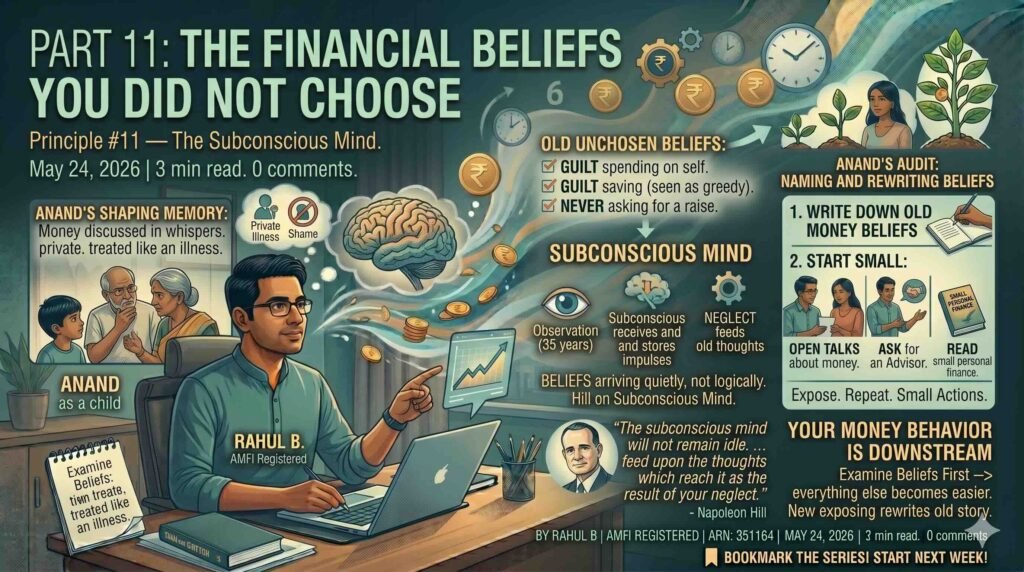
Anand grew up in a household where money was never discussed.
Not because the family was poor — they were comfortable. But money was treated like a private illness: something you did not talk about openly, something slightly shameful, something managed in whispers.
By the time Anand was 35 and earning well, he realised he had some strange patterns. He felt guilty spending money on himself. He felt equally guilty saving aggressively — as if it were greedy. He never asked for a raise, even when he knew he deserved one.
None of this was logical. None of it was chosen. It had arrived quietly, through thirty-five years of observation.
Hill on the subconscious
Napoleon Hill’s eleventh principle is the Subconscious Mind — the part of your mental life that operates below conscious awareness, stores every belief you have ever absorbed, and drives behaviour without asking your permission.
Hill says the subconscious receives and stores impulses of thought, regardless of their nature. Positive or negative, true or false — it accepts what is repeated and emotionally charged.
The good news, Hill insists, is that this is a two-way street. You can feed the subconscious deliberately — through affirmation, through repetition, through emotion-backed intention — and gradually replace old programming with new.
“The subconscious mind will not remain idle. If you fail to plant desires in your subconscious mind, it will feed upon the thoughts which reach it as the result of your neglect.” — Napoleon Hill
The money beliefs that run your life
Before you can manage your money well, it helps to understand what you actually believe about it.
Do you believe that people who are wealthy must have done something wrong to get there? Do you feel that asking for help with money is a sign of weakness? Do you believe that you are ‘not the kind of person’ who invests? That you are not smart enough, organised enough, or disciplined enough?
These beliefs are not facts. They are old inputs that have never been examined.
Anand’s audit
Anand spent one evening writing down every belief about money that he could remember hearing as a child. He was surprised how many there were — and how many of them were quietly running his adult financial life.
He did not fix them overnight. But naming them was the beginning. He started small: talking openly about money with his wife, asking a trusted friend to recommend an advisor, reading one personal finance book every quarter.
Slowly, his subconscious received new inputs. Not through willpower — through exposure, repetition, and small actions that rewrote the old story.
Your money behaviour is downstream of your money beliefs. Examine the beliefs first — everything else becomes easier.
Want to put these ideas to work in your own financial life? At rahulmoney.com, I help salaried professionals build simple, goal-based mutual fund portfolios. If you would like a free conversation to get started, reach out via the website.
Disclaimer: Mutual fund investments are subject to market risks. Please read all scheme-related documents carefully before investing. Rahul Bhaskarini | ARN: 351164 | rahulmoney.com