

Principle #12 — The Brain
Part 12 of 13 | Think and Grow Rich — Lessons for the Indian Investor
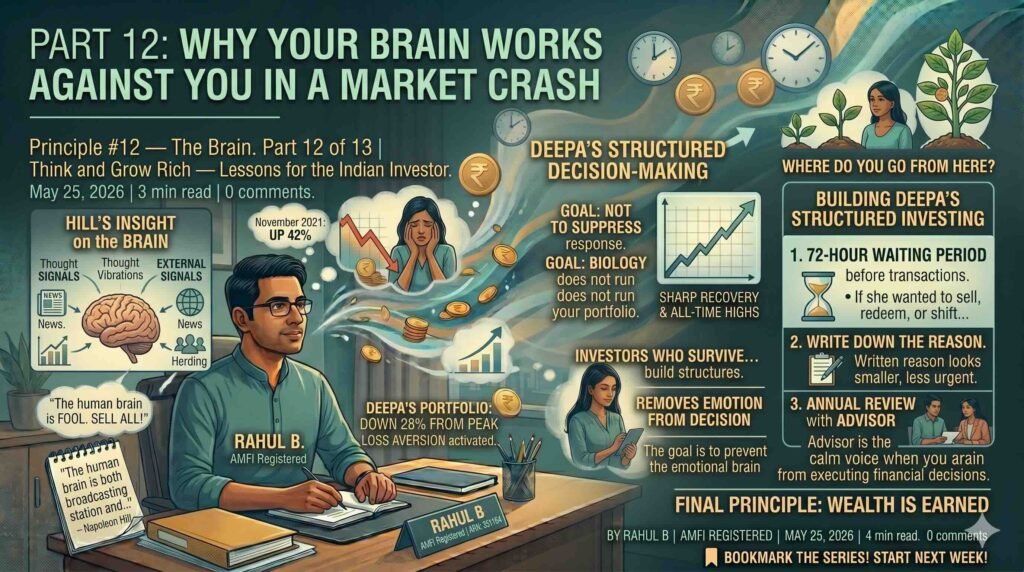
November 2021. Deepa’s portfolio was up 42% for the year. She felt like a genius.
June 2022. Same portfolio, down 28% from the peak. She felt like a fool.
Nothing about Deepa’s situation had fundamentally changed. She had the same job, the same income, the same long-term goals. Only the numbers on the screen had changed. But her emotional state was completely different — and so were the decisions she was about to make.
Hill’s view of the brain
Napoleon Hill’s twelfth principle deals with the brain as a broadcasting and receiving station — capable of picking up and transmitting thought impulses from the environment and from other minds.
In 1937, Hill was writing decades before behavioural economics existed as a field. But his central insight holds: the brain is not a neutral calculator. It is heavily influenced by external signals, by emotion, and by the mental environment around it.
What modern research has since confirmed is the specifics: loss aversion (losses feel roughly twice as painful as equivalent gains feel good), recency bias (we overweight what just happened), herding instinct (we are pulled toward what everyone else is doing).
“The human brain is both a broadcasting station and a receiving station for the vibration of thought.” — Napoleon Hill
What happens in your brain during a crash
When markets fall sharply, the amygdala — the brain’s threat-detection centre — activates. It is the same system that evolved to protect you from predators. It does not know the difference between a tiger and a portfolio statement.
The result: the urge to do something. To sell. To exit. To stop the pain. This response is not stupidity. It is biology.
The investors who survive crashes are not less emotional. They have built structures that prevent the emotional brain from executing financial decisions.
Deepa’s structure
Deepa added one rule to her investing practice after 2022: a 72-hour waiting period before any fund transaction. If she wanted to sell, redeem, or shift funds, she had to wait three days and write down her reason.
In those three days, the acute emotion usually passed. The reason she had written down often looked different — smaller, less urgent.
She also added an annual review with an advisor, whose job was to be the calm voice when she was not.
The goal is not to suppress your brain’s response to market volatility. The goal is to build enough structure around your decisions that your biology does not run your portfolio.
Want to put these ideas to work in your own financial life? At rahulmoney.com, I help salaried professionals build simple, goal-based mutual fund portfolios. If you would like a free conversation to get started, reach out via the website.
Disclaimer: Mutual fund investments are subject to market risks. Please read all scheme-related documents carefully before investing. Rahul Bhaskarini | ARN: 351164 | rahulmoney.com