

Principle #4 — Specialized Knowledge
Part 4 of 13 | Think and Grow Rich — Lessons for the Indian Investor
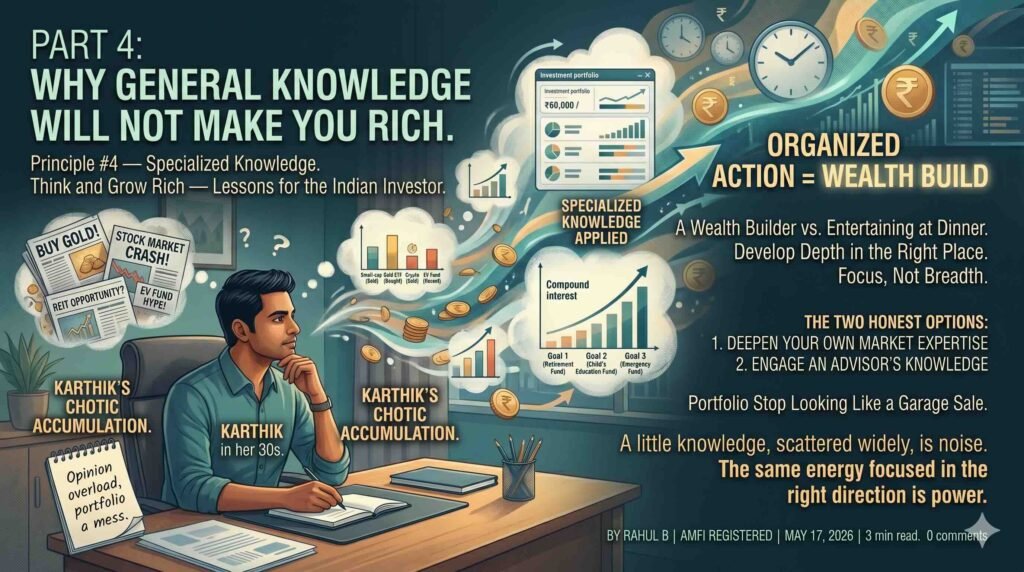
Karthik knew a lot about a lot of things.
He had read articles about the stock market, real estate, gold, fixed deposits, and cryptocurrency. He had watched finance reels on Instagram. He had opinions about everything and clarity about nothing.
Every few months, he moved money based on whatever he had last read. One year he was all-in on small-cap funds. The next year he sold everything to buy gold ETFs. Then came a REIT. Then a thematic fund focused on electric vehicles.
His portfolio looked like a garage sale. And it was returning like one too.
Napoleon Hill’s sharp distinction
Hill’s fourth principle is Specialized Knowledge — and he is careful to separate it from general knowledge.
‘An educated man is one who has so developed the faculties of his mind that he can acquire anything he wants,’ Hill writes. The key word is acquire. Not accumulate.
A man who knows a little about everything is entertaining at dinner. A man who knows a great deal about one useful thing can build wealth.
Hill’s advice is not to become an expert in everything. It is to either develop deep expertise in the one area you are pursuing, or to find someone who already has that expertise — and use it.
“Knowledge is only potential power. It becomes power only when — and if — it is organized into definite plans of action.” — Napoleon Hill
What this means for your investments
You do not need to understand every mutual fund in the market. You need to understand your own goals, your own risk capacity, and the handful of fund categories that serve those goals well.
That is specialized knowledge for an investor: not breadth, but depth in the right place.
Karthik’s problem was not ignorance. He had too much general information and no framework to use it. Every article he read triggered a new action. Every action had a cost — exit loads, tax, lost compounding.
The two honest options
Hill says there are two ways to access specialized knowledge: develop it yourself, or engage someone who has it.
If you enjoy reading about markets and have the time and temperament — build that expertise yourself. Track your decisions, review them, be honest about what is working.
If you do not — and most salaried professionals do not — find an advisor whose job it is to hold that knowledge for you. That is not weakness. That is the efficient use of your own time.
Karthik eventually sat down with someone who helped him simplify: three funds, one monthly SIP per goal, and a rule — no changes for at least twelve months. His portfolio stopped looking like a garage sale.
A little knowledge, scattered widely, is noise. The same energy focused in the right direction is power.
Want to put these ideas to work in your own financial life? At rahulmoney.com, I help salaried professionals build simple, goal-based mutual fund portfolios. If you would like a free conversation to get started, reach out via the website.
Disclaimer: Mutual fund investments are subject to market risks. Please read all scheme-related documents carefully before investing. Rahul Bhaskarini | ARN: 351164 | rahulmoney.com