

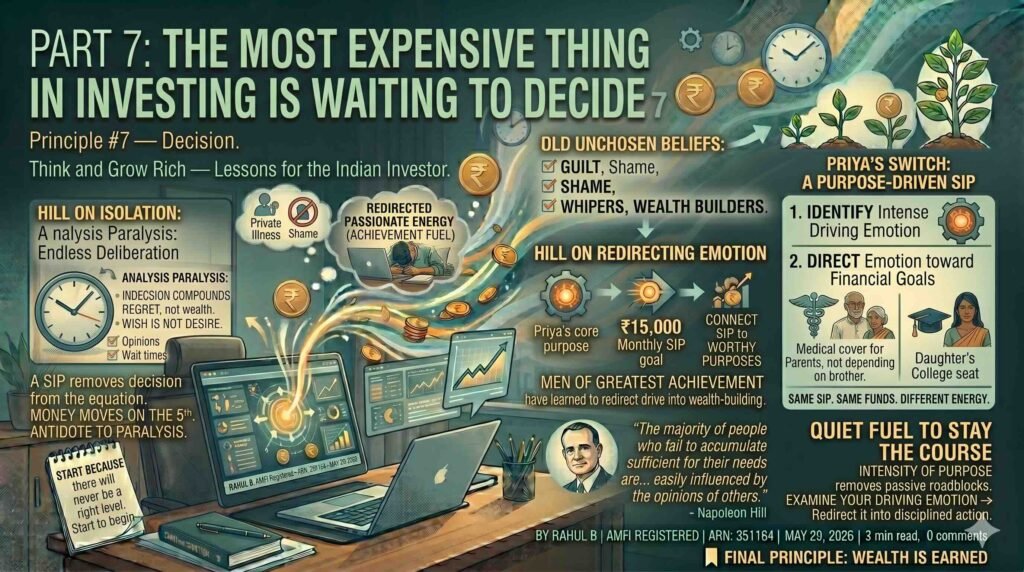
Principle #7 — Decision
Part 7 of 13 | Think and Grow Rich — Lessons for the Indian Investor
Rohit had been ‘thinking about’ starting a SIP for three years.
In year one, he waited because the market was at an all-time high. In year two, he waited because COVID had made everything uncertain. In year three, the market corrected, which felt like proof that he had been right to wait — and also like proof that he should wait a little longer.
Meanwhile, his colleague who had started a ₹10,000 SIP three years ago now had a corpus worth roughly ₹4.3 lakhs — with an investment of ₹3.6 lakhs.
Rohit had ₹0. And three more years of opinions about market timing.
Hill on decision-makers
Napoleon Hill studied 500 wealthy and successful people and found a common trait: they made decisions quickly and changed them slowly, if at all.
People who struggled financially, he observed, made decisions slowly — if they made them at all — and changed them quickly the moment any resistance appeared.
Hill is not saying make reckless decisions. He is saying that the habit of endless deliberation — ‘analysis paralysis’, as we now call it — is itself a decision. It is a decision to stay where you are.
“The majority of people who fail to accumulate money sufficient for their needs are, generally, easily influenced by the opinions of others.” — Napoleon Hill
Why investors are especially prone to this
The financial world produces an overwhelming volume of opinion. Every day, someone on television or the internet has a view about what the market will do next. This makes it very easy to always find a reason to wait.
The market is high — wait. The market is falling — wait. There is an election coming — wait. The rupee is weakening — wait.
Rohit was not a bad investor. He was an indecisive one. And indecision compounded just as surely as money does — except it compounded regret, not wealth.
The cure is boring
The antidote to this kind of paralysis is a SIP — because a SIP removes decision from the equation. Once it is set up, the money moves on the 5th of every month whether the market is up, down, or sideways.
Rohit finally started. Not because the market was at the right level. He started because he realised there would never be a right level — only the decision to begin.
The best time to start investing was when you first thought about it. The second best time is today. The worst time is never — which is what waiting forever quietly becomes.
Want to put these ideas to work in your own financial life? At rahulmoney.com, I help salaried professionals build simple, goal-based mutual fund portfolios. If you would like a free conversation to get started, reach out via the website.
Disclaimer: Mutual fund investments are subject to market risks. Please read all scheme-related documents carefully before investing. Rahul Bhaskarini | ARN: 351164 | rahulmoney.com