

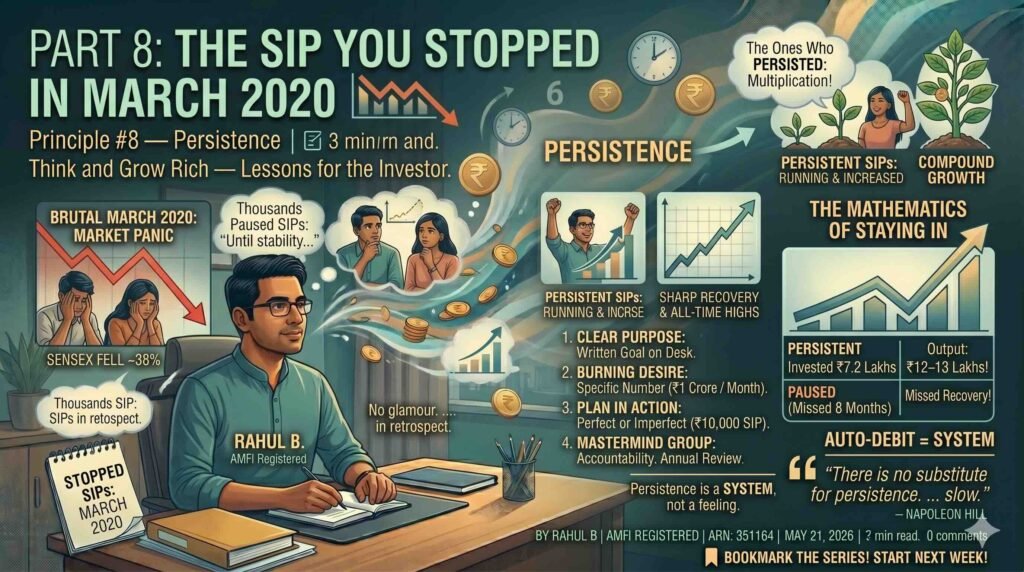
Principle #8 — Persistence
Part 8 of 13 | Think and Grow Rich — Lessons for the Indian Investor
March 2020 was a brutal month.
The Sensex fell nearly 38% in a matter of weeks. Portfolios that had taken years to build looked unrecognisable. SIP statements arrived like bad news. WhatsApp groups were full of panic.
Thousands of investors paused their SIPs. ‘Just for now,’ they told themselves. ‘Until things stabilise.’
Some of them never started again.
The ones who kept their SIPs running — or better, increased them — watched those same units multiply over the following eighteen months, as the market recovered sharply and then went on to make all-time highs.
What Hill says about persistence
Napoleon Hill calls persistence the sustained effort necessary to induce faith. It is, he says, the direct result of habit — and like all habits, it can be cultivated deliberately.
He lists the symptoms of a lack of persistence: the habit of putting off what needs to be done, lack of interest, blaming others or market conditions when things go wrong, quitting at the first sign of opposition.
He lists the antidotes too: a clear purpose, a burning desire for a specific outcome, a plan that is in action — however imperfect — and a mastermind group that holds you accountable.
“There is no substitute for persistence. It cannot be supplanted by any other quality. Remember this — and it will hearten you when the going seems difficult and slow.” — Napoleon Hill
The mathematics of staying in
Persistence in a SIP is not glamorous. It does not feel like anything on most months. The power of it only becomes visible in retrospect.
An investor who ran a ₹10,000 SIP from January 2018 to January 2024 through COVID, the Russia-Ukraine conflict, the rate hike cycle, and everything else — invested ₹7.2 lakhs and ended up with roughly ₹12–13 lakhs, depending on the fund.
The investor who paused in March 2020 and missed eight months missed the sharpest recovery of that entire period.
Persistence is a system, not a feeling
No one feels like staying invested when the market is falling. Persistence, as Hill defines it, is not about feeling confident. It is about having a system that removes feeling from the equation.
Auto-debit is a system. A written goal on your desk is a system. An annual review with someone who will tell you the truth is a system.
The market will test your patience at least twice in every decade. The investors who build wealth are not those who predicted the recovery — they are those who simply did not stop.
Want to put these ideas to work in your own financial life? At rahulmoney.com, I help salaried professionals build simple, goal-based mutual fund portfolios. If you would like a free conversation to get started, reach out via the website.
Disclaimer: Mutual fund investments are subject to market risks. Please read all scheme-related documents carefully before investing. Rahul Bhaskarini | ARN: 351164 | rahulmoney.com