

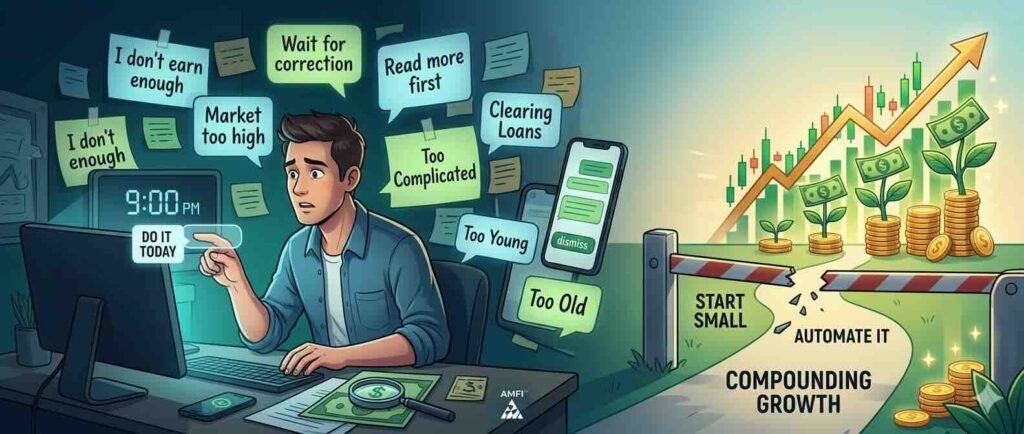
Arjun’s calendar reminder went off at 9:00 PM.
“Start SIP – DO IT TODAY”
He’d been setting this reminder for three months. And for three months, he’d been dismissing it with a different excuse each time.
Month 1: “The market is too high right now. I’ll wait for a correction.”
Month 2: “I just paid my insurance premium. I’ll start next month when I have more cash flow.”
Month 3: “I should read more about mutual funds first. I don’t want to pick the wrong one.”
Tonight, staring at the notification, Arjun realized something uncomfortable:
He wasn’t delaying because of market conditions or cash flow or knowledge gaps.
He was delaying because he was afraid. And excuses were just fear wearing a mask of logic.
—
What Is Excusitis?
David Schwartz dedicates an entire chapter of The Magic of Thinking Big to what he calls “excusitis”—a disease that’s more common than the flu and far more dangerous.
Excusitis is the habit of manufacturing excuses to justify inaction.
It’s not lying. It’s not laziness. It’s something subtler: it’s the brain’s defense mechanism against risk, uncertainty, and the discomfort of trying something new.
When it comes to money, excusitis sounds like this:
– “I don’t earn enough to invest.” – “The market is too volatile right now.” – “I’ll start once I clear my loans.” – “Mutual funds are too complicated.” – “I’m too young to think about retirement.” – “I’m too old to start now.”
Every excuse feels rational in the moment. But here’s the trap:
Excuses protect you from failure. But they also protect you from success.
—
The Four Types of Money Excusitis
Schwartz identifies four main forms of excusitis. Let’s translate them into the language of personal finance.
1. **Health Excusitis** → *”I’m Too Stressed to Think About Money”*
Ravi worked in IT consulting. Long hours, high pressure, constant deadlines. Whenever someone mentioned financial planning, he’d say:
“I’m already stressed about work. I can’t deal with the mental load of tracking investments too.”
The excuse felt valid. Stress is real. Mental bandwidth is limited.
But here’s the truth: financial stress doesn’t go away by ignoring it. It compounds.
Ten years later, Ravi was still stressed about work—and stressed about having no savings, no emergency fund, and no plan for retirement.
The cure: Automate it.
Ravi didn’t need to “think” about investing. He needed to set up a ₹5,000 SIP once, let it run on autopilot, and forget about it. The mental load? Five minutes of setup. That’s it.
2. **Intelligence Excusitis** → *”I’m Not Smart Enough to Understand Investing”*
Priya used to say this all the time.
“Finance isn’t my strong suit. I barely passed math in school. How am I supposed to understand P/E ratios and portfolio diversification?”
This excuse is seductive because it sounds humble. But humility isn’t the same as helplessness.
The truth? You don’t need to be a finance expert to build wealth. You need to understand three things:
1. Start early. 2. Invest regularly (SIP). 3. Stay invested (don’t panic-sell).
That’s it. The rest is noise.
The cure: Start with index funds.
Priya didn’t need to pick stocks or analyze balance sheets. She just needed to invest in a Nifty 50 or Sensex index fund and let it grow. No stock-picking genius required.
3. **Age Excusitis** → *”I’m Too Young / Too Old to Start”*
The “Too Young” Version:
Arjun at 24: “I’m just starting my career. I’ll focus on earning first, then think about investing later.”
By 30, he’d lost six years of compounding. If he’d started at 24 with ₹5,000/month SIP at 12% CAGR, he’d have ₹6.1 lakhs by 30. Instead, he had ₹50,000 in a savings account.
The “Too Old” Version:
Rekha’s uncle at 48: “I’m almost 50. What’s the point of starting now? I should’ve done this 20 years ago.”
If he started a ₹15,000/month SIP at 48 and retired at 60, he’d still accumulate ₹42 lakhs (at 12% CAGR). Not bad for “too late.”
The cure: The best time to start was 10 years ago. The second-best time is today.
4. **Luck Excusitis** → *”Rich People Just Got Lucky”*
This is the most dangerous excuse because it absolves you of responsibility.
“Rekha bought property in 2015 when prices were low. She got lucky.”
“Arjun’s company gave ESOPs. That’s why he’s doing well. I don’t have that.”
“My friend invested in a stock that 10x’d. That’s pure luck. I’d never pick the right one.”
Luck exists. But attributing all success to luck is just a way to avoid admitting: I could do this too. I’m just not doing it.
The cure: Focus on what you can control.
You can’t control market timing. You can control starting a SIP. You can’t control ESOPs. You can control upskilling to switch to a better-paying job. You can’t control stock picks. You can control investing in diversified mutual funds.
—
Arjun’s Excuse Inventory (And What He Found)
After three months of ignoring his reminder, Arjun decided to confront his excusitis head-on.
He opened a notes app and listed every excuse he’d used to delay investing:
1. “The market is too high right now.” 2. “I should wait for a correction.” 3. “I need to research the best funds first.” 4. “I just paid a big bill. I’ll start next month.” 5. “I don’t have enough saved up to make it worthwhile.”
Then he asked himself: What’s the real reason behind each excuse?
The answers were uncomfortable:
1. “I’m afraid the market will crash right after I invest.” 2. “I’m afraid I’ll pick the wrong fund and lose money.” 3. “I’m afraid I’ll need this money in an emergency and regret locking it up.”
Every excuse boiled down to one word: Fear.
Fear of loss. Fear of mistakes. Fear of commitment.
The excuses weren’t protecting him from risk. They were protecting him from trying.
—
How Arjun Cured His Excusitis
Schwartz’s prescription for excusitis is simple but not easy: Stop making excuses and start making progress.
Here’s how Arjun did it:
Step 1: Call Out the Excuse
Every time an excuse surfaced, Arjun wrote it down and labeled it.
“I should wait for a correction.” → Market Timing Excusitis
“I need to research more.” → Paralysis by Analysis Excusitis
Naming it made it visible. And once it was visible, it lost its power.
Step 2: Replace the Excuse with a Question
Instead of: “I don’t have enough to invest.”
He asked: “How much do I have? Can I start with that?”
Instead of: “The market is too high.”
He asked: “Has waiting for the perfect time ever worked for anyone? Or do people who invest regularly end up ahead regardless of timing?”
Questions opened doors. Excuses slammed them shut.
Step 3: Take the Smallest Action Possible
Arjun didn’t need to invest ₹10,000/month on Day 1. He didn’t need to pick the “perfect” fund.
He just needed to start.
He opened his banking app, selected a flexi-cap fund, and set up a ₹3,000/month SIP.
Not ideal. Not optimal. But done.
And the moment he hit “Confirm,” the excuses lost their grip.
Step 4: Build the Habit First, Optimize Later
For the first six months, Arjun didn’t touch his SIP. He didn’t check returns daily. He didn’t panic when the market dipped 8%.
He just let it run.
After six months, his portfolio was worth ₹19,200 (contributions: ₹18,000, gains: ₹1,200).
Was it life-changing? No.
But it proved something crucial: I can do this. It’s not as scary as I thought.
In Month 7, he increased the SIP to ₹5,000. In Month 12, to ₹7,000. By Year 2, he was investing ₹10,000/month without even thinking about it.
The excuses? Gone.
—
The Five Most Common Money Excuses (And How to Kill Them)
Excuse #1: *”I don’t earn enough to invest.”*
Reality Check: If you can afford Netflix, Zomato, and weekend coffee runs, you can afford ₹1,000/month SIP.
Action: Track your expenses for one month. Find ₹1,000 of waste. Redirect it to a SIP.
—
Excuse #2: *”I’ll start once I clear my loans.”*
Reality Check: Waiting to clear loans before investing means you lose years of compounding. You can do both.
Action: Start a small SIP (₹2,000/month) while paying down loans. Build the habit now, scale later.
—
Excuse #3: *”The market is too high / too volatile / about to crash.”*
Reality Check: Market timing doesn’t work. Even experts get it wrong. SIPs work because you invest regardless of market levels.
Action: Stop checking the Sensex. Start your SIP. Trust the process.
—
Excuse #4: *”I need to learn more before I start.”*
Reality Check: You’ll never feel “ready.” Knowledge is infinite. Action creates clarity.
Action: Pick one index fund (Nifty 50 or Sensex). Start a ₹2,000 SIP. Learn while doing.
—
Excuse #5: *”I’m bad with money. I’ll just mess it up.”*
Reality Check: Nobody is born “good with money.” It’s a skill. Skills are learned through practice, not theory.
Action: Start small. Make mistakes. Adjust. Repeat. You’ll get better by doing, not by avoiding.
—
What Happens When You Stop Making Excuses
Two years after curing his excusitis, Arjun looked back at his notes app.
The list of excuses he’d written down felt almost comical now.
“I should wait for a correction.” → The market had gone up 18% since then. Waiting would’ve cost him ₹40,000 in missed gains.
“I need to research more.” → He’d picked a flexi-cap fund in 10 minutes. It had returned 14.2% CAGR. The “perfect” fund he would’ve spent months researching? Probably returned 13.8%.
“I don’t have enough saved up to make it worthwhile.” → His ₹3,000/month SIP, which felt “too small” back then, had grown to ₹89,000 (₹72,000 invested + ₹17,000 gains).
The excuses had felt so real. So logical. So protective.
But in reality, they’d just been fear dressed up as prudence.
—
The Uncomfortable Truth About Excuses
Here’s what Schwartz understood that most people miss:
Excuses aren’t designed to protect you from failure. They’re designed to protect your ego.
If you never try, you never fail. And if you never fail, you never have to admit: I wasn’t good enough. I didn’t have what it takes.
But here’s the twist:
Not trying is the only guaranteed failure.
Arjun could’ve spent the rest of his life blaming the market, his salary, his lack of knowledge. And he would’ve been right—those things were real obstacles.
But they weren’t insurmountable. They were just convenient.
The moment he stopped making excuses and started making progress—even imperfect, messy, scared progress—the path appeared.
—
Next in the series: From Fear to Freedom: Why Starting Small Builds Wealth Faster Than Waiting for Perfect
—
Disclaimer: This article is for educational purposes only. Mutual fund investments are subject to market risks. Please read all scheme-related documents carefully before investing. The author is a SEBI-registered Mutual Fund Distributor (ARN 351164). Past performance is not indicative of future returns.