

Lessons for the Indian Investor
A 13-Part Series | rahulmoney.com
Introduction | Think and Grow Rich — Lessons for the Indian Investor
The Book That Changed How I Think About Money
My name is Rahul B. I am a solution architect by profession and a AMFI-registered Mutual Fund Distributor at rahulmoney.com.
But before all of that — I was simply a salaried professional in Hyderabad, trying to figure out what to do with my money.
One evening, I picked up a book that a family member had recommended. Think and Grow Rich by Napoleon Hill.
I had heard the name before. I had never thought it was relevant to me.
I started reading. I did not put it down until 3 AM.
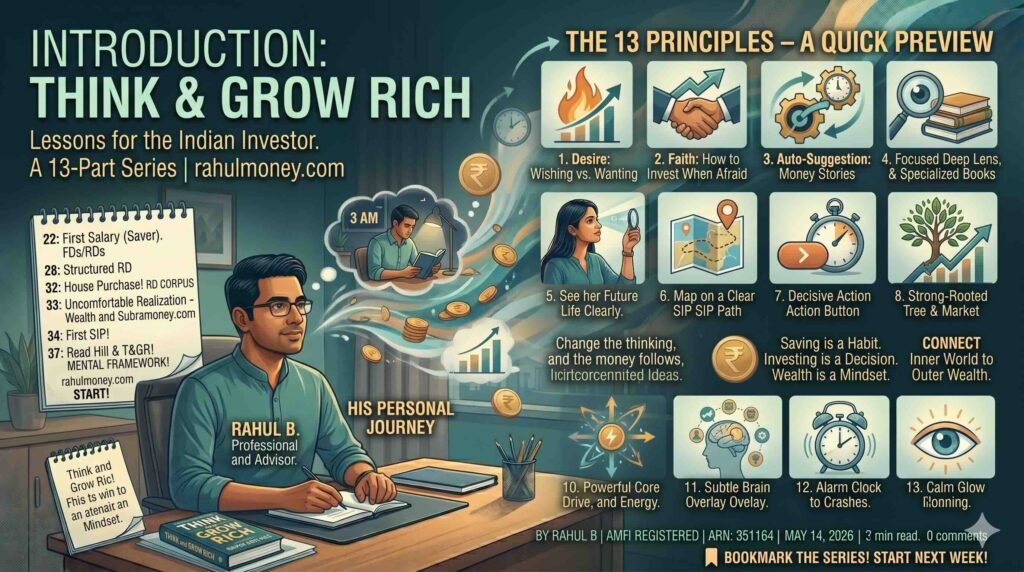
How my money journey actually began
To be honest, Think and Grow Rich was not my very first step. Let me take you back a little further.
I started earning at 22 — fresh out of college, first job, first salary. From the very beginning, I was a saver. Fixed Deposits, Recurring Deposits — these were my comfort zone. The bank was familiar, the returns were guaranteed, and I knew exactly where my money was at all times. While many of my friends spent freely, I was quietly putting money aside every month.
At 28, I doubled down on this habit and started a more structured Recurring Deposit. Safe, predictable, and disciplined — exactly the kind of saving I had always believed in.
And that discipline paid off. Over the next four years, I saved consistently through RDs. At 32, I used that accumulated corpus — along with a home loan — to buy my own house. That was a proud moment. The RD had done its job.
But once the dust settled after the house purchase, I started noticing something uncomfortable. The RD returns, after inflation and taxes, were not really growing my remaining money in any meaningful way. I was saving — but I was not building wealth. There had to be something more.
That is when I stumbled upon a blog called subramoney.com — written by P V Subramaniam, one of India’s most respected personal finance educators. He posted daily. Clear, simple, no-nonsense writing about money, mutual funds, SIPs, and financial planning for ordinary Indians.
I read his posts every single day. Sometimes two or three at a time, going back through his archives. He had a way of making complex things feel simple — and more importantly, he made me feel like investing in mutual funds was something a regular salaried person like me could actually do.
That was my real turning point. I opened my first SIP because of what I learned from his blog.
Think and Grow Rich came later — and it gave me the mental framework to understand why I had been delaying for so long, and what it would take to stay the course.
Who was Napoleon Hill — and why does a 1937 book still matter?
Napoleon Hill was an American author who spent over twenty years studying the most successful people of his era — including Andrew Carnegie, Henry Ford, and Thomas Edison.
Andrew Carnegie, one of the richest men in history, commissioned Hill to interview hundreds of successful people and find the common principles behind their success. The result was Think and Grow Rich, published in 1937.
The book has sold over 100 million copies worldwide. It is still one of the most recommended personal development books — not because it teaches you stock tips or financial formulas, but because it goes deeper than that.
It talks about the mind. About belief. About habits, plans, persistence, and the invisible forces that either push us toward wealth or quietly keep us away from it.
Napoleon Hill’s central idea: your outer financial life is a reflection of your inner mental life. Change the thinking, and the money follows.
Now, Hill wrote this in 1937 in America. Some of his language feels old-fashioned. Some of his examples do not apply to our world today.
But the principles? The principles are timeless. And when you apply them to the Indian context — to salaried professionals, rising EMIs, anxious families, and the beautiful but confusing world of mutual funds — they become surprisingly practical.
What this series is about
Think and Grow Rich has 13 core principles. Over the next 13 posts, we will explore one principle at a time — through the stories of everyday Indian characters like Ravi, Arjun, Priya, Meera, Deepa, and others.
These are not real people. But they are very real situations. You may recognise yourself in some of them.
Each post will:
— Tell a short story of an Indian investor facing a real financial challenge
— Explain one principle from Think and Grow Rich in simple, plain English
— Connect it to something practical in your own investing life
— Leave you with one idea you can act on this week
We will not use complicated financial jargon. We will not talk about which fund to buy right now. This series is about something more important — the mindset that makes good financial decisions possible in the first place.
What happened when I finished the book?
By the time I finished Think and Grow Rich, something had shifted.
I already had my SIPs running — I had learned about those from subramoney.com. But the book gave me something different. It gave me the mental framework to understand why so many people delay, why discipline alone is not enough, and what it truly takes to stay the course through market ups and downs.
It connected the inner world — beliefs, habits, persistence, purpose — to the outer world of money and investing. That connection changed how I think about financial decisions, and eventually led me to start rahulmoney.com to help other salaried professionals do the same.
Saving is a habit. Investing is a decision. But building real wealth — that is a mindset. That is what this series is about.
The 13 principles — a quick preview
Here is what we will cover across the series:
Post 1 — Desire: Why wishing is not the same as wanting
Post 2 — Faith: How to invest when you are afraid
Post 3 — Auto-Suggestion: The stories you tell yourself about money
Post 4 — Specialized Knowledge: Why knowing a little about everything hurts your portfolio
Post 5 — Imagination: The investor who could not picture her future
Post 6 — Organized Planning: Wanting it is not enough — you need a map
Post 7 — Decision: The most expensive thing in investing is waiting to decide
Post 8 — Persistence: The SIP you stopped in March 2020
Post 9 — The Mastermind: The hidden advantage of having the right people around you
Post 10 — Drive: The energy behind every serious investor
Post 11 — The Subconscious Mind: The financial beliefs you did not choose
Post 12 — The Brain: Why your brain works against you in a market crash
Post 13 — The Sixth Sense: When you know, without being told, that you are on the right path
Bookmark this series. Share it with a friend or family member who has been thinking about starting their investing journey for a while.
If any part of my story sounds familiar — the cautious saver looking for something more, the realisation that FDs and RDs alone are not enough, the search for a trusted voice to learn from — then this series was written for you.
We start next week with Principle 1: Desire.
The best financial decisions are not made in the mind alone. They are made when the mind and the heart are pointing in the same direction.
Want to start your own investing journey with a simple, goal-based plan? At rahulmoney.com, I help salaried professionals in India get started with mutual fund SIPs — without jargon, without pressure. Reach out for a free conversation.
Disclaimer: Mutual fund investments are subject to market risks. Please read all scheme-related documents carefully before investing. Rahul Bhaskarini | ARN: 351164 | rahulmoney.com