

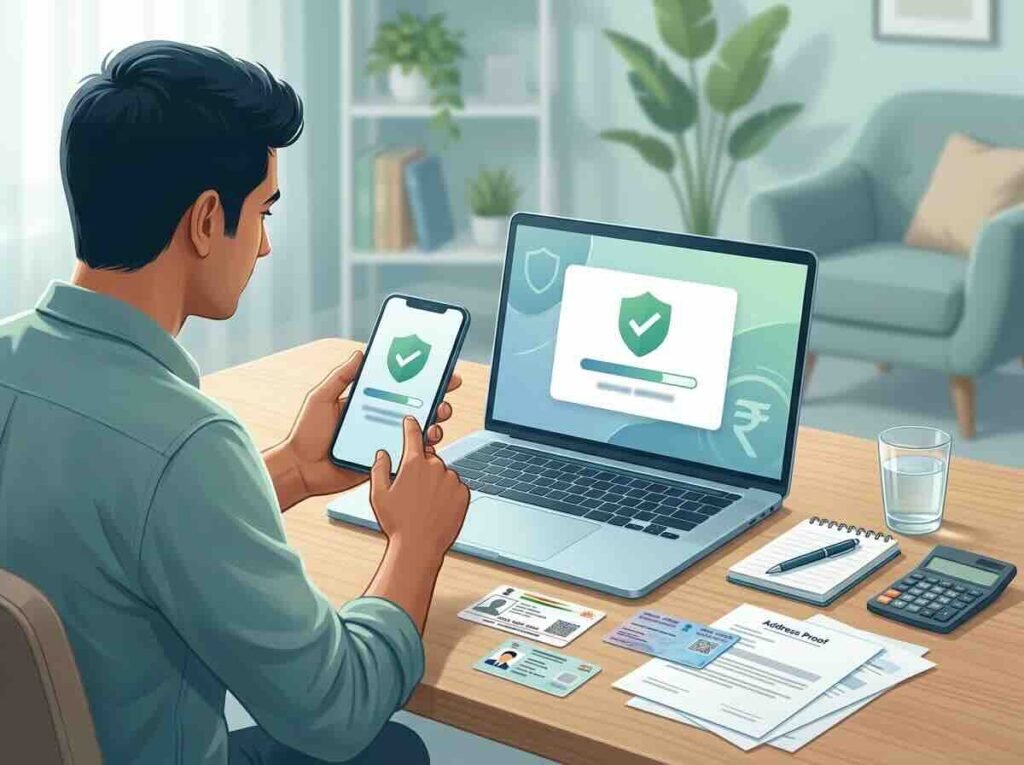
If you have ever tried to open a bank account, invest in a mutual fund, or buy insurance online, you have almost certainly encountered the term KYC. It stands for Know Your Customer, and it is a mandatory process for almost every financial service in India. Here is what it means, why it exists, and how to complete it.
What is KYC?
KYC — Know Your Customer — is a regulatory process through which financial institutions verify your identity and address before allowing you to use their services.
It exists to prevent financial crimes: money laundering, terrorism financing, fraud, and identity theft. By verifying who their customers are, banks, mutual fund companies, and insurers comply with RBI and SEBI regulations.
What documents are required for KYC?
For individuals in India, KYC typically requires:
Identity proof (any one):
– Aadhaar card
– PAN card
– Passport
– Voter ID
– Driving licence
Address proof (any one):
– Aadhaar card (if address is current)
– Utility bill (electricity, water, gas — not older than 3 months)
– Bank statement
– Passport
– Rental agreement
PAN card is mandatory for investments above ₹50,000 and is required for all mutual fund investments regardless of amount.
KYC for mutual funds: CKYC and KRA
For mutual fund investing, your KYC is managed through KYC Registration Agencies (KRAs). SEBI has centralised this — once you complete KYC through any one mutual fund company or platform, it is valid for all mutual fund investments in India.
CKYC (Central KYC) is a government-run central registry. If you have completed CKYC (through a bank or financial institution), that KYC number is valid across most financial products.
You can check your KYC status at the CAMS KRA website, Karvy KRA, or directly on AMC platforms.
How to complete KYC
Option 1 — eKYC (easiest and fastest): Done online using Aadhaar-based OTP verification. No documents to submit, no branch visits. The entire process takes less than 5 minutes on platforms like Groww, Zerodha Coin, or Paytm Money. eKYC is valid for most purposes.
Option 2 — Video KYC: A short video call with a representative of the financial institution. You show your documents on camera. Valid for full KYC.
Option 3 — In-person KYC: Visit the branch or a KYC collection centre with original documents and self-attested copies. This is the traditional method, now largely replaced by digital options.
Is KYC a one-time thing?
Yes — and no.
For most purposes, completing KYC once means you are KYC-compliant across all mutual funds and many other financial services. You do not need to redo it for every new fund or platform.
However, financial institutions are required to periodically re-verify KYC — typically every 2 years for some customer categories, longer for standard accounts. You may receive reminders from your bank or investment platform when re-verification is needed.
Also, if your address changes, update your KYC across all your financial accounts to avoid service disruptions.
Common KYC-related problems and solutions
Problem: KYC rejected or pending — usually due to blurry photo or address mismatch.
Solution: Resubmit with a clearer image or a different address proof document.
Problem: PAN and Aadhaar not linked — since 2023, unlinking these can freeze investments.
Solution: Link PAN and Aadhaar on the Income Tax portal immediately if not already done.
Problem: KYC done under old process — some older KYC registrations need to be validated against the new CKYC system.
Solution: Log in to any investment platform and follow the KYC update process.
The bottom line
KYC is a one-time process that unlocks access to mutual funds, insurance, banking, and virtually every financial service in India. With eKYC via Aadhaar OTP, it takes under 10 minutes and can be done entirely from your smartphone.
Do it once, keep your PAN and Aadhaar linked, update your address when it changes, and you will have no KYC-related friction in your investing journey.