

Peter Lynch’s Fundamental Inventory — Part 3 of 3
Arjun had come a long way.
He had stopped watching the Sensex every morning. He had learned to evaluate whether a stock’s price made sense. His portfolio had quietly started growing for the first time.
And then he made one very costly mistake.
When his best-performing stock fell 18% during a broad market correction — he panicked. He sold everything.
Two months later, the same stock was up 35%.
He had done everything right — identified the business, checked the price, bought with conviction. And then he undid it all in a single emotional decision made at 11pm while reading bad news on Twitter.
Peter Lynch had a rule for exactly this moment. In fact, he had eleven of them.
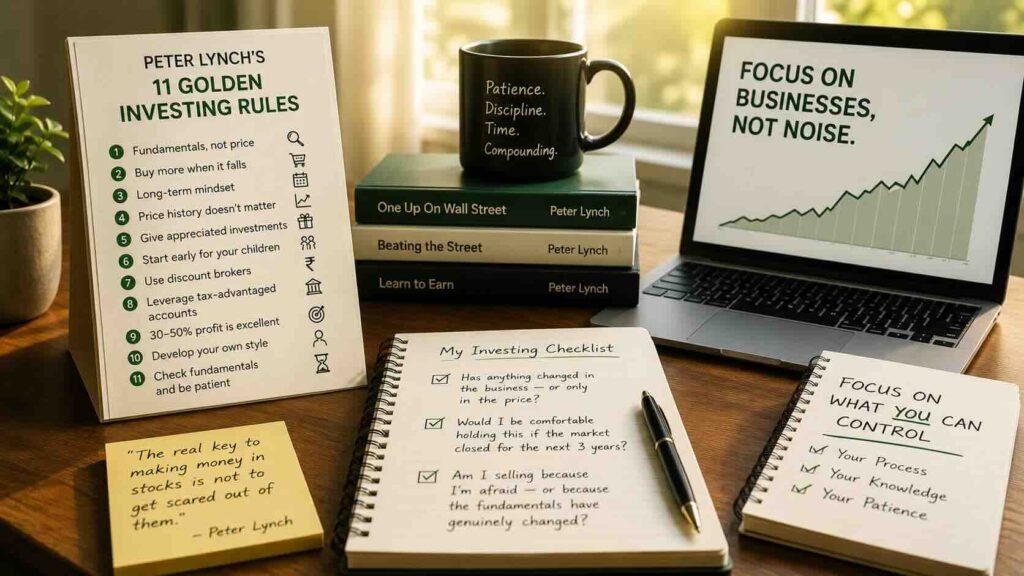
Lynch’s 11 Golden Rules — With Arjun’s Honest Notes
• When fundamentals change — sell. Not when the price drops. Not when the news turns negative. Only when the underlying business actually deteriorates. Arjun’s note: Check the company. Not the chart.
• If the stock falls but fundamentals are intact — buy more. This is what separates great long-term investors from the rest. Fear creates opportunity for the disciplined.
• Go for long-term gains. Real wealth in equities is built over 5 to 10 years — not 5 to 10 weeks. Lynch held his best stocks for years.
• A stock’s historical price means nothing. Just because a stock once traded at ₹800 does not mean it will return to ₹800. Every price is determined by today’s fundamentals — not nostalgia.
• Give appreciated investments to family or charity. In India, gifting equity-linked savings can be tax-efficient in certain situations. Always consult your CA for your specific circumstances.
• Start investing for your children early. Compounding rewards patience far more than intelligence. A ₹500 monthly SIP started for a child at age 5 can mean crores by retirement — at a modest 12% CAGR.
• Use discount brokers. Zerodha, Groww, and similar platforms have made equity investing affordable and transparent for every Indian. High brokerage costs silently erode long-term returns.
• Use tax-advantaged accounts strategically. ELSS mutual funds under Section 80C save tax while building long-term equity wealth. Put your higher-churn investments in tax-efficient wrappers.
• A 30–50% profit in 12 months is excellent — don’t be greedy. Over 30–50% growth in 3 years in a large-cap company is genuinely rare. Recognise it. Celebrate it. Don’t assume it will continue indefinitely.
• Develop your own investing style — and stick to it. Value investor? Growth investor? SIP investor? Know your approach, understand your risk tolerance, and don’t abandon it every time markets get volatile.
• Keep checking the fundamentals — and be patient. Patience is the single most underrated skill in investing. Lynch held stocks for years. The Indian market rewards those who can sit still.
“In this business, if you’re good, you’re right six times out of ten. You’re never going to be right nine times out of ten.” — Peter Lynch
The Rule That Changed Arjun
Of all eleven rules, Rule 2 hit Arjun the hardest.
Buy more when the stock falls — but only when the fundamentals are unchanged.
He had done the exact opposite. He had sold when the price fell, even though the company’s order book was growing, management was intact, and there was no change in the business at all. He had let fear — not logic — make his investment decision.
So Arjun made himself a simple one-page checklist — his personal version of Lynch’s rules — to read before making any buy or sell decision:
• Has anything changed in the business — or only in the price?
• Would I be comfortable holding this if the market closed for the next 3 years?
• Am I selling because I’m afraid — or because the fundamentals have genuinely changed?
These three questions, he found, stopped nine out of ten bad decisions before they happened.
Arjun’s Portfolio — One Year Later
Twelve months after discovering Peter Lynch, Arjun’s portfolio looked very different.
Not because he found secret stocks. Not because he got lucky with a tip. Not because of a bull market.
But because he fundamentally changed how he thought about investing.
He stopped reacting to headlines — and started reading quarterly results.
He stopped selling in panic — and started buying when prices fell and fundamentals held.
He stopped checking his portfolio every evening — and started reviewing it every quarter.
And his returns? Quietly, steadily — they started compounding.
“The real key to making money in stocks is not to get scared out of them.” — Peter Lynch
What If You Don’t Have Time for All This?
Not everyone can spend hours each week reading annual reports, calculating PEG ratios, and analysing balance sheets.
That is completely fine. And Lynch himself acknowledged it.
Equity mutual funds managed by professional fund managers apply exactly these principles — across a well-diversified portfolio — on your behalf. Every day, without you needing to do anything.
A systematic SIP in the right equity mutual fund gives you:
• Lynch-style fundamental research — done by professionals with full-time resources
• Rupee cost averaging — so market dips automatically work in your favour
• Tax efficiency — especially through ELSS funds under Section 80C
• The full power of compounding — without you needing to time the market
• Emotional discipline — because SIPs invest automatically, removing fear from the equation
You don’t need to become Peter Lynch.
You just need to start thinking like him — and then take one small step today.
This was Part 3 of a 3-part series on Peter Lynch’s Fundamental Inventory.
Part 1: Stop Watching Sensex. Start Watching Businesses.
Part 2: Is This Stock Cheap or Expensive?
Find all articles in this series at rahulmoney.com
Professional References
Sources and further reading for this article:
[1] One Up on Wall Street — Peter Lynch (Simon & Schuster) — Primary source. Lynch’s 21 rules are detailed in Part III of the book.
[2] Beating the Street — Peter Lynch — Lynch’s second book — explores long-term patience and portfolio discipline.
[3] The Psychology of Money — Morgan Housel (Harriman House) — Highly recommended companion read on investor behaviour and emotional discipline.
[4] AMFI India — SIP Calculator & Fund Selection — Official AMFI SIP calculator to model your long-term compounding.
[5] ELSS Funds & Section 80C — SEBI Investor Guide — SEBI’s guide to tax-saving mutual funds under the Income Tax Act.
[6] Morningstar India — Fund Research & Ratings — Independent mutual fund ratings and analysis for Indian investors.
[7] Value Research Online — Mutual Fund Data India — India’s most trusted independent mutual fund research platform.
Want to invest like Peter Lynch — without picking stocks yourself?
Start a SIP in a well-managed equity mutual fund. I’ll help you pick the right one for your goal.
📲 Start your SIP → rahulmoney.com
ARN: 351164 | AMFI Registered Mutual Fund Distributor
Disclaimer: Mutual Fund investments are subject to market risks. Read all scheme-related documents carefully. This content is for educational purposes only and does not constitute investment advice. SEBI/AMFI Registered MFD | ARN: 351164